How did accounts of gold offerings become the search for an entire city made wealthy beyond measure?
Sixteenth century–present
The story
What we know
El Dorado originally referred in some early accounts to a gilded person rather than a place. European stories associated the name with a Muisca ruler and offerings at Lake Guatavita. Over time, the imagined wealth expanded into a city or kingdom sought across northern South America. The changing target reveals as much about colonial ambition as about Indigenous history. [1][2]
More context & timeline
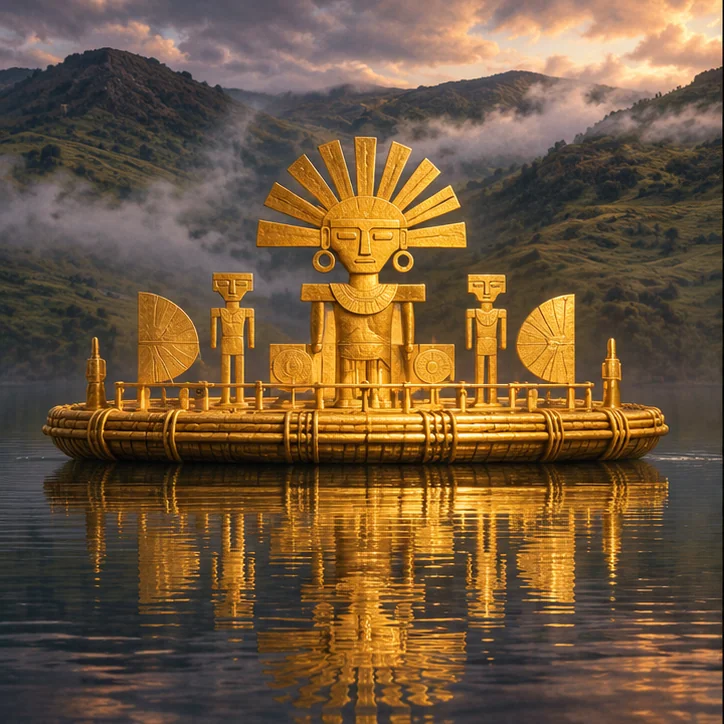
The Museo del Oro’s Muisca raft was found near Pasca in 1969, in a cave rather than at the bottom of Guatavita. The museum identifies it as a votive work and traditionally interprets the scene in relation to the ceremony behind El Dorado accounts. It is powerful evidence of Muisca metalwork and offering traditions, not proof that a golden city existed. [1][2]
Sixteenth century
European accounts connect immense wealth with a gilded ruler and shift toward a place. [1]
1630s
A later colonial account describes a Muisca investiture ceremony associated with Guatavita. [3]
1969
The Muisca raft is found in a cave near Pasca and enters the museum collection. [2]
Look closely
Follow the evidence
These imagined scenes evoke Muisca cultural history and later legends; they are not faithful artifact reproductions or evidence of a discovered city of gold.
AI illustration · imagined scene
Evidence 1
The name changes its object
LACMA distinguishes the gilded person of early accounts from the imagined city. A search can continue indefinitely if its proposed location and even its object change whenever an expedition fails. [1]
AI illustration · imagined scene
Evidence 2
A raft with a recorded findspot
The museum’s account locates the raft’s discovery at Pasca. Its scene can be compared with written traditions, but moving its findspot mentally to Guatavita would manufacture a stronger connection than archaeology actually supplies. [2]
AI illustration · imagined scene
Evidence 3
Later writing about earlier practice
Banco de la República’s account identifies the best-known colonial description as late. Chronology matters: a detailed written scene is still mediated through a colonial author, rather than a direct transcript of a pre-conquest event. [3]
1 / 3
Interpret the evidence
Fact, record and legend
Follow a possibility. Weigh what supports it. See where the evidence stops.
AI artwork sets the scene; it does not reconstruct an established answer.
AIExplore an explanationA historical offering tradition behind the story
The support
Gold objects, raft imagery and colonial accounts support investigating Muisca ceremonies and the significance of offerings. [2]
The limit
An object’s interpretation and a later description cannot establish every detail or frequency of a particular ceremony. [2]
AIExplore an explanationColonial desire enlarging a report
The support
European accounts and expeditions transformed a gilded ruler into a much larger promise of wealth. [1]
The limit
Tracing that transformation explains the legend’s expansion without showing that every European account had an identical origin. [1]
AIExplore an explanationA still-hidden city matching the legend
The support
The accumulated stories encouraged searches across immense areas. [1]
The limit
The sources cited here provide no archaeological identification of the fabulous golden city. Genuine ancient settlements elsewhere cannot automatically authenticate that specific claim. [1]
If a real object supports part of a story, which additional claims still need evidence before the entire legend can be accepted?
AI illustration · imagined scene
Connected place
Museo del Oro / Banco de la República
The public collection interpretation connects the Muisca raft with its archaeological and cultural context.
Left panel extracted from a generated triptych and optimized as WebP without enlargement. The original PNG and generation prompt are preserved in the project artwork ledger.
Scene artwork is AI-generated editorial illustration. Real photographs and original records retain their separate credits.
Sources & further reading
Original TrekBoundX writing. Research reviewed November 25, 2026. Source links do not imply institutional endorsement.