
All mysteries

Lost treasures

The Irish Crown Jewels

0 of 3 evidence items examined
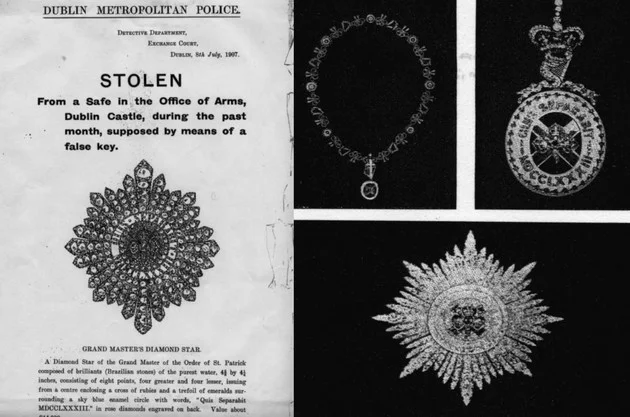
An archival police handout with black-and-white illustrations of the stolen Irish Crown Jewels.View image
Archival police notice

How did ceremonial jewels leave a guarded castle without a proven thief?

1907

The story

What we know

On July 6, 1907, an office messenger at Dublin Castle found the regalia’s safe closed but unlocked. Its contents were missing. These Irish Crown Jewels were insignia of the Order of St Patrick, rather than an actual crown. Their disappearance embarrassed the administration and ended a custodian’s career. [2]

More context & timeline

Sir Arthur Vicars, Ulster King of Arms, was responsible for the valuables. A specially built strongroom existed, but the free-standing safe was too large to fit inside it and remained in the Office of Arms library. Physical arrangements matter more to this investigation than the grandeur suggested by the popular name. [2]
  1. 1831

    New insignia are supplied for the Order’s Grand Master. [2]

  2. July 6, 1907

    The theft is discovered shortly before Edward VII’s visit. [1]

  3. 1908

    Correspondence questions the private nature and scope of the inquiry. [3]

Look closely

Follow the evidence

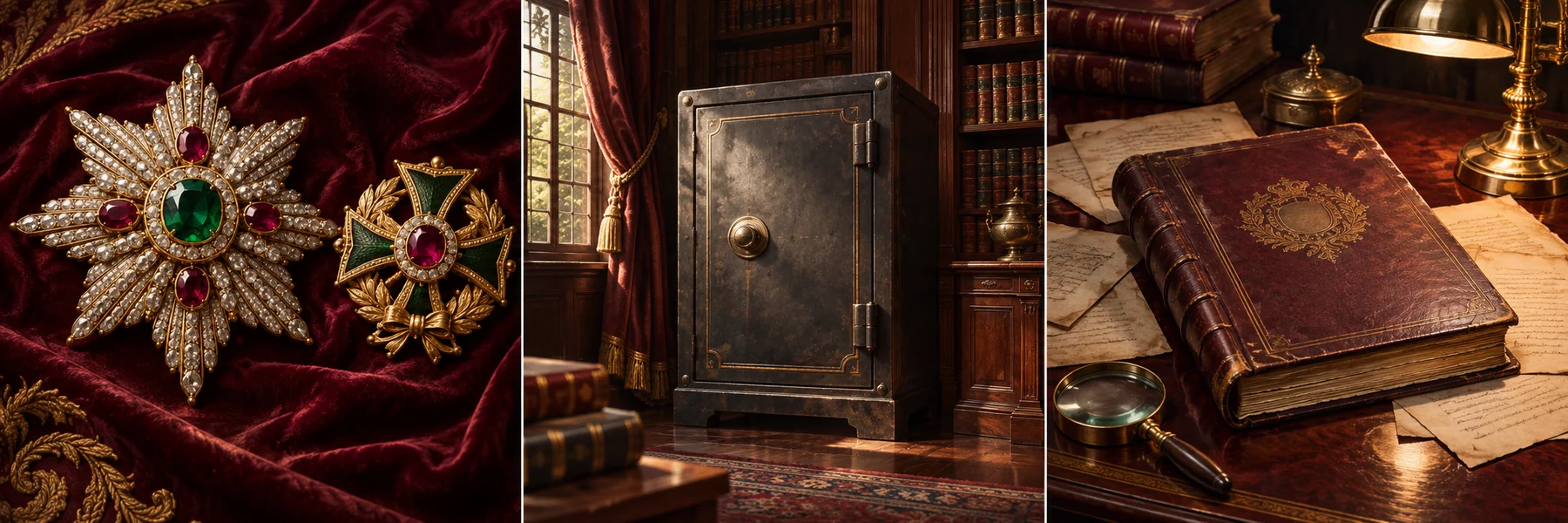
Imagined regalia and records. These are not photographs of recovered jewels or a reconstruction of the theft.

AI-generated editorial illustration: Imagined ceremonial star and badge
AI illustration · imagined scene
Evidence 1

The safe’s location

The safe stood in the library rather than the intended strongroom. The discovery records describe it as unlocked, so this was not simply a case of thieves breaking through an impressive locked barrier. [2]

AI-generated editorial illustration: An imagined historic library safe
AI illustration · imagined scene
Evidence 2

Keys and opportunities

Vicars held both safe keys, one personally and another at home. Reports of security lapses and other people’s access created several possible routes to the contents. Access still has to be linked to a particular act. [1]

AI-generated editorial illustration: A symbolic inquiry report
AI illustration · imagined scene
Evidence 3

Questions about the inquiry

National Library correspondence records demands for a public inquiry and questions about whether anyone was being shielded. Those questions preserve contemporary concern; they do not themselves prove a cover-up or identify a thief. [3]

Interpret the evidence

What could explain it?

Follow a possibility. Weigh what supports it. See where the evidence stops.

AI artwork sets the scene; it does not reconstruct an established answer.

Explore an explanationA theft using insider access

The support

The lack of a forced lock and weaknesses in key control support an investigation of people able to obtain access. [1]

The limit

Opportunity does not identify a thief. Francis Shackleton was suspected, but the accusation did not become a proved solution. [1]

Explore an explanationA planned operation through an intermediary

The support

Later accounts propose that someone arranged access while another person removed the regalia. That would separate planning from physical presence. [2]

The limit

The curated Castle exhibition identifies such narratives as interpretations, including a fictionalised book. Their details must not be mistaken for established findings. [2]

How would an inquiry designed to judge a custodian’s conduct differ from one designed to identify a thief?
An archival police handout with black-and-white illustrations of the stolen Irish Crown Jewels.
Archival police notice

Connected place

Dublin Castle

The documented setting of the theft and the Office of Arms.

Visitor guide

The jewels remain missing. A visit cannot include viewing the stolen regalia; follow the Castle’s current visitor information for access.

AI-generated editorial illustration: A symbolic inquiry report
AI illustration · imagined scene

Keep investigating

Step beyond the story.

Explore the connected place, examine the records, and form your own reading of the evidence.

Photo credits & full-image view
A 1907 police handout illustrating the stolen Irish Crown Jewels.

Dublin Metropolitan Police · Image source · Public domain (1907 police handout)

Resized without enlargement and converted to WebP; orientation follows source metadata. No manual crop or content alteration. The complete downloaded frame is preserved; card or banner display crops may be used. Image derivatives retain the stated rights or license.

Scene artwork is AI-generated editorial illustration. Real photographs and original records retain their separate credits.

Sources & further reading

Original TrekBoundX writing. Research reviewed November 24, 2026. Source links do not imply institutional endorsement.

  1. Office of Public Works / Dublin CastleThe Theft of the Irish Crown JewelsExamine the source
  2. Office of Public Works / Dublin CastleThe King’s Room: Splendour and ScandalExamine the source
  3. National Library of IrelandCorrespondence concerning the theft of the Irish Crown Jewels, 1908Examine the source
  4. National Library of IrelandSir Arthur Vicars papers relating to the loss, 1907–1908Examine the source
Suggest a correction
All mysteriesNext mysteryThe Missing Just Judges

The Irish Crown Jewels — image

An archival police handout with black-and-white illustrations of the stolen Irish Crown Jewels.
A 1907 police handout illustrating the stolen Irish Crown Jewels.

Dublin Metropolitan Police · Image source · Public domain (1907 police handout)

Resized without enlargement and converted to WebP; orientation follows source metadata. No manual crop or content alteration. The complete downloaded frame is preserved; card or banner display crops may be used. Image derivatives retain the stated rights or license.