Where does the documented manhunt end and the later survival legend begin?
1865
The story
What we know
John Wilkes Booth shot Abraham Lincoln at Ford’s Theatre on April 14, 1865. Lincoln died the next morning. The attack belonged to a broader plot against government leaders: William Seward was attacked, while the assigned attack on Andrew Johnson was not carried out. Booth fled south with assistance from several people. [1][2][3]
More context & timeline
The National Park Service records Booth’s death at the Garrett farm on April 26. Pursuers trapped him in a tobacco barn, where he was shot; he subsequently died. Claims that a substitute died and Booth escaped developed outside this documented conclusion. They are historical claims to evaluate, not an alternative ending established by equivalent evidence. [1][2][3]
April 14–15, 1865
Lincoln is attacked at Ford’s Theatre and dies at the Petersen House. [1]
April 1865
Booth and David Herold travel through Maryland and across the Potomac. [2]
April 26, 1865
The manhunt reaches Garrett’s farm; Booth is fatally wounded. [3]
Look closely
Follow the evidence
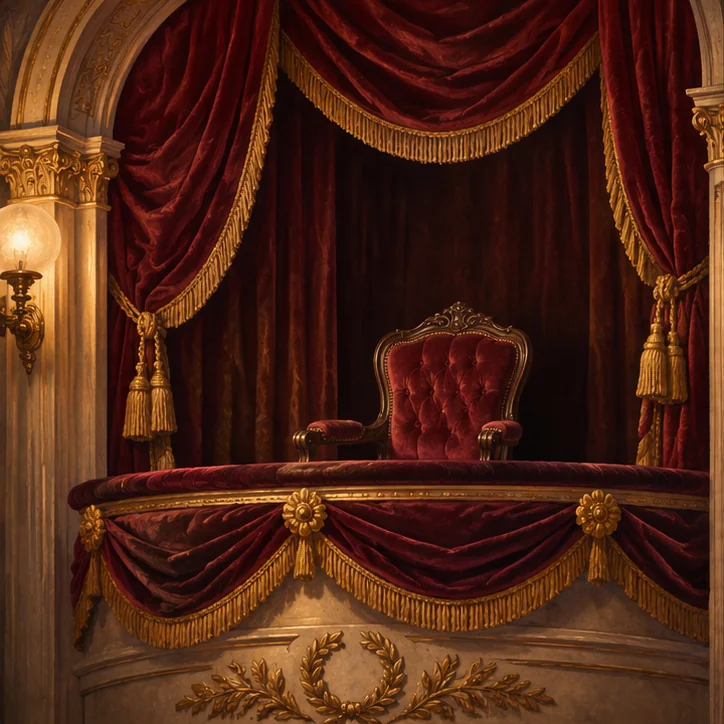
Illustrations evoke documented settings without depicting the killing, a victim, Booth’s likeness, or an alleged escape as fact.
AI illustration · imagined scene
Evidence 1
A route with human witnesses
The Park Service reconstructs a flight involving hiding places, guides and a difficult river crossing. Each encounter supplies a point to test. A survival claim must explain this connected trail as well as its proposed substitute at the end. [2]
AI illustration · imagined scene
Evidence 2
Reports from the pursuing force
The Army history draws on contemporary pursuit reports and testimony for the confrontation at the barn. These are records of people directly involved, although their perspectives and conduct still require scrutiny. [3]
AI illustration · imagined scene
Evidence 3
News close to the event
The Library of Congress preserves an 1865 report of Booth’s capture and death. Contemporary reporting is not infallible, but its existence makes clear that the death account was not invented generations later to answer a survival legend. [4]
1 / 3
Interpret the evidence
Fact, record and legend
Follow a possibility. Weigh what supports it. See where the evidence stops.
AI artwork sets the scene; it does not reconstruct an established answer.
AIExplore an explanationThe documented conclusion
The support
Booth’s flight ended at Garrett’s farm, where he was shot and died. Park Service and Army histories agree on that outcome. [1]
The limit
Questions about the pursuers’ choices and particular recollections remain distinct from establishing that Booth survived. [1]
AIExplore an explanationEscape through a substituted identity
The support
Survival stories propose another man at the barn and a concealed later life. Such a scenario would explain why a claimant appeared elsewhere. [3]
The limit
The sources here provide no verified chain linking a later claimant to Booth or displacing the documented death. [3]
AIExplore an explanationA real conspiracy enlarged by later storytelling
The support
The assassination involved collaborators and multiple intended targets, giving later writers authentic secrecy to build upon. [1]
The limit
Evidence of that plot does not prove every later allegation about a wider network or a successful escape. [1]
What evidence would a later identity claim need before it could outweigh several connected accounts made during the manhunt?
AI illustration · imagined scene
Connected place
Ford’s Theatre National Historic Site
The theatre and Petersen House interpret Lincoln’s assassination and its aftermath.
Consult current Park Service visitor information. The route crosses separate sites with different access arrangements.
AI illustration · imagined scene
Keep investigating
Step beyond the story.
Explore the connected place, examine the records, and form your own reading of the evidence.
Photo credits & full-image view
AI-generated editorial illustration for The Lincoln assassination, Booth’s flight and escape claims. It is an imagined scene, not a historical photograph or source evidence.
Left panel extracted from a generated triptych and optimized as WebP without enlargement. The original PNG and generation prompt are preserved in the project artwork ledger.
Scene artwork is AI-generated editorial illustration. Real photographs and original records retain their separate credits.
Sources & further reading
Original TrekBoundX writing. Research reviewed November 25, 2026. Source links do not imply institutional endorsement.