What kind of evidence could distinguish an unknown animal from a familiar animal seen badly?
1933–present
The story
What we know
Reports associated with Loch Ness reached a mass audience in the 1930s. A long-necked, prehistoric-looking animal became the familiar image, reinforced by the 1934 photograph often called the surgeon’s photograph. Museum interpretation identifies that famous picture as a hoax. Its collapse does not explain every sighting, but it removes a supposed cornerstone of proof. [1][2]
More context & timeline
In 2018, a University of Otago-led team collected 250 water samples for environmental-DNA analysis; findings were announced in 2019. The survey found abundant eel DNA and no evidence of the proposed prehistoric reptile. Crucially, DNA detection does not reveal the size of the eels. “There are eels” and “a giant eel explains Nessie” are different conclusions. [1][2]
1933–1934
Modern publicity grows and the famous long-neck photograph circulates. [1]
2018
Researchers collect water samples for environmental-DNA testing. [2]
2019
The team reports abundant eel DNA, without establishing giant eels. [2]
Look closely
Follow the evidence
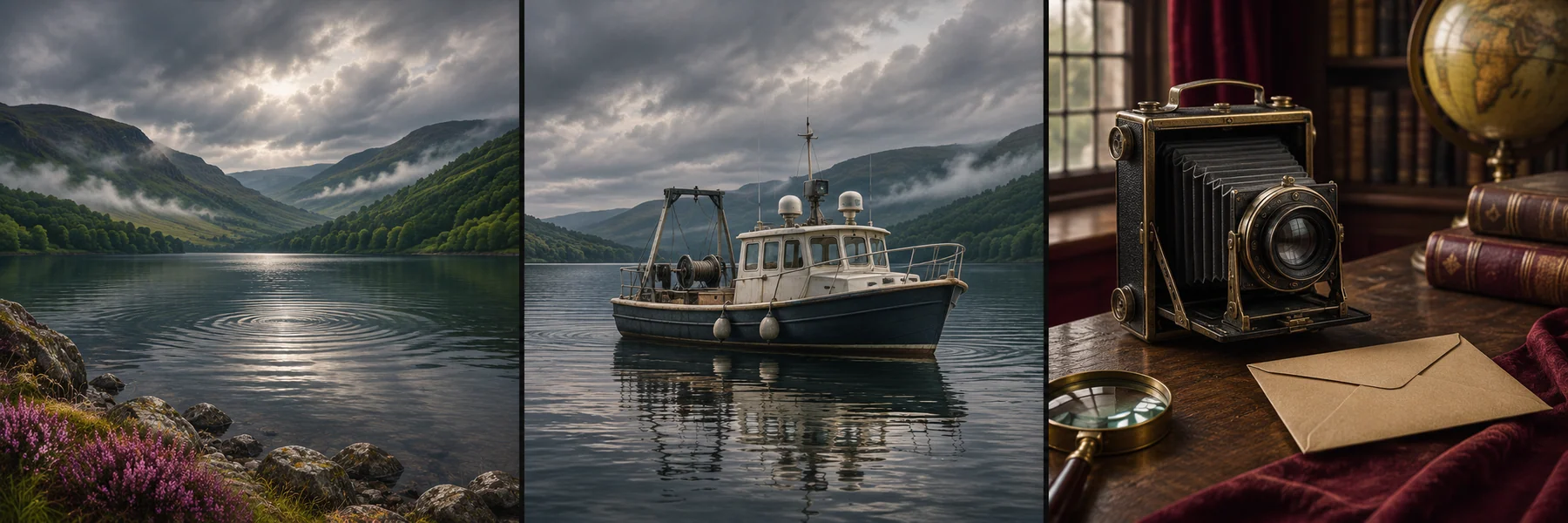
The scenes evoke the landscape and investigation without manufacturing a monster sighting, sonar return, footprint, or historical photograph.
AI illustration · imagined scene
Evidence 1
An image with a history
The Science Museum Group preserves a newspaper-library print of the famous photograph and explains its hoax background. A surviving archival photograph can be genuine as an object while the scene it supposedly depicts is deceptive. [1]
AI illustration · imagined scene
Evidence 2
Biological traces without body size
Environmental DNA provides a way to look for organisms without catching them. The Otago account explicitly separates detecting eels from measuring them. A large quantity of eel DNA is not a measurement of a large individual. [2]
AI illustration · imagined scene
Evidence 3
A prehistoric comparison that can be checked
The Natural History Museum explains plesiosaurs as extinct marine reptiles and traces the changing appearance attributed to Nessie. Familiarity with the silhouette in popular culture should not substitute for evidence of a living population. [3]
1 / 3
Interpret the evidence
Fact, record and legend
Follow a possibility. Weigh what supports it. See where the evidence stops.
AI artwork sets the scene; it does not reconstruct an established answer.
AIExplore an explanationKnown animals interpreted under poor viewing conditions
The support
The loch contains real wildlife, and eels provide one biological candidate for some reports. [2]
The limit
The DNA survey did not match any particular sighting to an eel or demonstrate an animal of the reported enormous size. [2]
AIExplore an explanationA photograph or story deliberately constructed
The support
The famous 1934 image is an established example of fabrication influencing what later viewers expected to see. [1]
The limit
One exposed hoax does not establish that every witness was deceptive; the remaining reports must be assessed separately. [1]
AIExplore an explanationA surviving prehistoric reptile
The support
The long-necked appearance invites comparison with a plesiosaur. [3]
The limit
No verified specimen or population has established that interpretation, and the cited survey did not produce reptile evidence supporting it. [3]
Which would tell you more: another distant image with no scale, or a small biological sample collected under independently documented conditions?
AI illustration · imagined scene
Connected place
Science Museum Group collections
An archival photograph provides a public lesson in photography, scale and deception.
Left panel extracted from a generated triptych and optimized as WebP without enlargement. The original PNG and generation prompt are preserved in the project artwork ledger.
Scene artwork is AI-generated editorial illustration. Real photographs and original records retain their separate credits.
Sources & further reading
Original TrekBoundX writing. Research reviewed November 25, 2026. Source links do not imply institutional endorsement.