
All mysteries

Treasure and legend · Folklore & evidence

The Lost Dutchman: A Mine Made of Stories?

0 of 3 evidence items examined
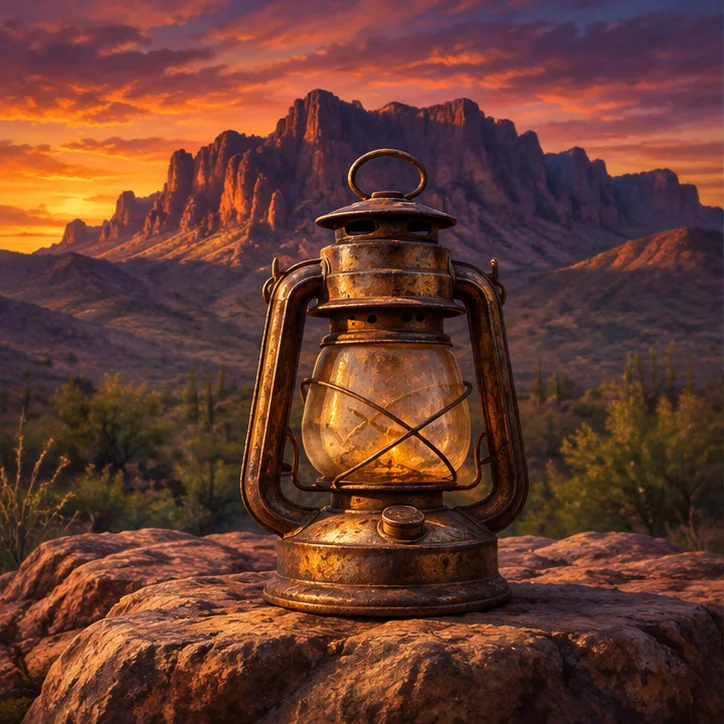
AI-generated editorial illustration: A closed miner’s lantern before a distant desert mountain silhouette.View image
AI illustration · imagined scene

How did one prospector’s story become a landscape of promised gold?

Nineteenth century–present

The story

What we know

The Lost Dutchman legend connects Jacob Waltz with rich gold in Arizona’s Superstition Mountains. Versions accumulated around supposed discoveries and secrets. Start by establishing the person, dating the stories, and distinguishing a documented memorial from a proven mine. [1] [2] [3]

More context & timeline

Arizona’s state library catalogues a historical account under folklore and treasure subjects. Local heritage research documents Waltz’s grave and the later effort to memorialise him. Official tourism presents the story as part of the park’s identity. These sources establish a powerful tradition, not an independently authenticated hidden deposit. [1] [2] [3]
  1. 1891

    Waltz’s death becomes a reference point for later accounts of the lost-mine story. [1]

  2. 1936–1938

    Local enthusiasts seek a grave memorial and then erect a Lost Dutchman monument. [2]

  3. 1969 onward

    Further grave improvements demonstrate the legend’s continuing public appeal. [2]

Look closely

Follow the evidence

Imagined imagery for a Southwestern treasure legend. No real mine, concealed entrance, route, or verified gold deposit is represented.

AI-generated editorial illustration: A closed miner’s lantern before a distant desert mountain silhouette.
AI illustration · imagined scene
Evidence 1

A person and a mine need separate proof

A burial record or memorial can establish a real individual’s historical presence. It cannot establish that all treasure stories subsequently attached to that individual are true. [2]

AI-generated editorial illustration: A broad Sonoran Desert landscape.
AI illustration · imagined scene
Evidence 2

Publication gives a story a date

A surviving book lets researchers ask what was being claimed by the time it appeared. A later written account is not automatically an eyewitness record of the original discovery. [1]

AI-generated editorial illustration: An unmarked notebook and imagined mining token.
AI illustration · imagined scene
Evidence 3

Commemoration changes the landscape

Markers, museum interpretation, and a park name help visitors encounter the legend. Their existence is evidence of remembrance and tourism, not geological authentication. [3]

Interpret the evidence

Fact, record and legend

Follow a possibility. Weigh what supports it. See where the evidence stops.

AI artwork sets the scene; it does not reconstruct an established answer.

Explore an explanationA genuine mining experience grew in retelling

The support

A real prospector’s activities provide a possible starting point for stories about a valuable source known to one person. [3]

The limit

The sources reviewed do not establish the claimed mine or validate an exact route. A plausible beginning cannot authenticate later directions. [3]

Explore an explanationSeveral traditions became one lost fortune

The support

Folklore can accumulate names, events, and dramatic details until listeners expect a single coherent solution. [1]

The limit

That process must be studied through dated versions rather than assumed. It does not establish that every detail was deliberately invented or that a particular claimant knew the truth. [1]

Does giving a legend a monument make the story more reliable—or simply easier to remember?
AI-generated editorial illustration: A closed miner’s lantern before a distant desert mountain silhouette.
AI illustration · imagined scene

Connected place

Lost Dutchman State Park

A public landscape where visitors can learn about the region and the legend.

Visitor guide

Use official park information for current permitted activities. No mine entrance, treasure route, off-trail search, or private property access is proposed.

AI-generated editorial illustration: An unmarked notebook and imagined mining token.
AI illustration · imagined scene

Keep investigating

Step beyond the story.

Explore the connected place, examine the records, and form your own reading of the evidence.

Photo credits & full-image view
AI-generated editorial illustration for The legend of the Lost Dutchman. It is an imagined scene, not a historical photograph or source evidence.

Created for TrekboundX · Image source · AI artwork details

Left panel extracted from a generated triptych and optimized as WebP without enlargement. The original PNG and generation prompt are preserved in the project artwork ledger.

Scene artwork is AI-generated editorial illustration. Real photographs and original records retain their separate credits.

Sources & further reading

Original TrekBoundX writing. Research reviewed November 25, 2026. Source links do not imply institutional endorsement.

  1. Arizona State Library, Archives and Public RecordsThe Story of Jacob Walzer: Superstition Mountain and Its Famed Dutchman’s Lost Mine, catalogue recordExamine the source
  2. Ed Dobbins / Pioneers’ Cemetery Association heritage researchOn the Origin of Jacob Waltz’s Gravestone; A Short History of Improvements at Jacob Waltz’s GravesiteExamine the source
  3. Arizona Office of TourismLost Dutchman State ParkExamine the source
Suggest a correction
All mysteriesNext mysteryThe RFK Assassination: Verdict and Records

The Lost Dutchman: A Mine Made of Stories? — image

AI-generated editorial illustration: A closed miner’s lantern before a distant desert mountain silhouette.
AI-generated editorial illustration for The legend of the Lost Dutchman. It is an imagined scene, not a historical photograph or source evidence.

Created for TrekboundX · Image source · AI artwork details

Left panel extracted from a generated triptych and optimized as WebP without enlargement. The original PNG and generation prompt are preserved in the project artwork ledger.