What produced one remarkable detection that has never been securely repeated?
1977; archival research continues
The story
What we know
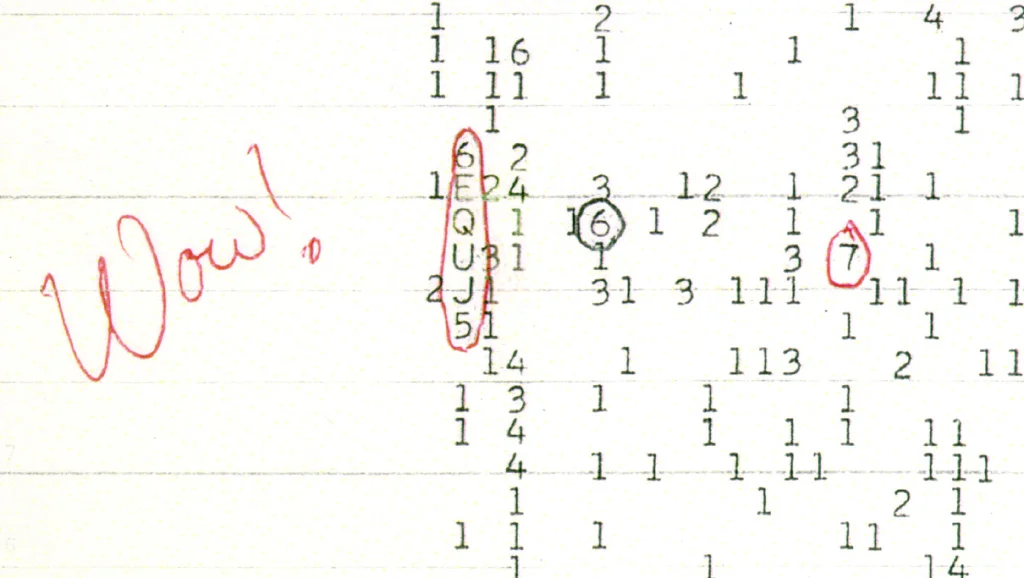
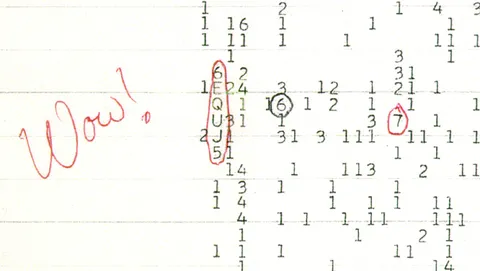
On August 15, 1977, Ohio State’s Big Ear radio telescope registered an unusually strong narrowband signal. Reviewing the computer printout afterward, Jerry Ehman marked the sequence and wrote Wow! The observation became famous without yielding an identified source or a decoded communication. [1][2]
More context & timeline
The telescope printed measurements rather than recording audio. Its observing system limited what could be reconstructed about short-term variations. The event was interesting to researchers searching for technological signals, but an interesting candidate is not established evidence of extraterrestrial intelligence. [1][2]
AI atmosphere, not the actual signal record, an audio recording or evidence of extraterrestrial intelligence.
AI illustration · imagined scene
Evidence 1
Strength, not words
The six characters encode changing intensity in the instrument’s notation. They are not an alphabet received from space, and reading them as a sentence begins with a false premise. [1]
AI illustration · imagined scene
Evidence 2
A telescope beam crossing
The rise and fall resembled the response expected as a compact sky source crossed the beam. Detection in only one receiving beam also constrains possible duration and location. [1]
AI illustration · imagined scene
Evidence 3
The archive can change the question
A current reanalysis revises inferred frequency, intensity, and sky position. Its September 2026 page stresses continuing calibration and interpretation. Improved estimates help test explanations without identifying a source. [3]
1 / 3
Interpret the evidence
What could explain it?
Follow a possibility. Weigh what supports it. See where the evidence stops.
AI artwork sets the scene; it does not reconstruct an established answer.
AIExplore an explanationA technological transmitter
The support
Strong narrowband emission made the event relevant to searches for engineered signals. [5]
The limit
No repeated detection or independently confirmed transmitter establishes that interpretation. A candidate star is a search target, not an identified sender. [5]
AIExplore an explanationA natural hydrogen-cloud event
The support
The Arecibo Wow! team proposes a rare brightening associated with hydrogen and a transient radiation source. [4]
The limit
This is a research hypothesis, not a demonstrated reconstruction of the 1977 event. Similar weaker signals do not automatically identify this one. [4]
AIExplore an explanationInterference or an instrumental effect
The support
Radio astronomers must test terrestrial and instrumental alternatives before claiming a cosmic discovery. [4]
The limit
The beam-shaped profile and other checks make simple interference explanations difficult; no specific alternative has been conclusively established. [4]
If another telescope detected a similar signal, what would you need to show that it came from the same source?
Original scientific record scan
Connected place
Ohio History Connection / Wow! signal archive
A public digital record of the Ohio observation and its original printout.
Resized without enlargement and converted to WebP; orientation follows source metadata. No manual crop or content alteration. The complete downloaded frame is preserved; card or banner display crops may be used. Image derivatives retain the stated rights or license.
Scene artwork is AI-generated editorial illustration. Real photographs and original records retain their separate credits.
Sources & further reading
Original TrekBoundX writing. Research reviewed November 24, 2026. Source links do not imply institutional endorsement.