
All mysteries

Lost tombs

Alexander’s Missing Tomb

0 of 3 evidence items examined
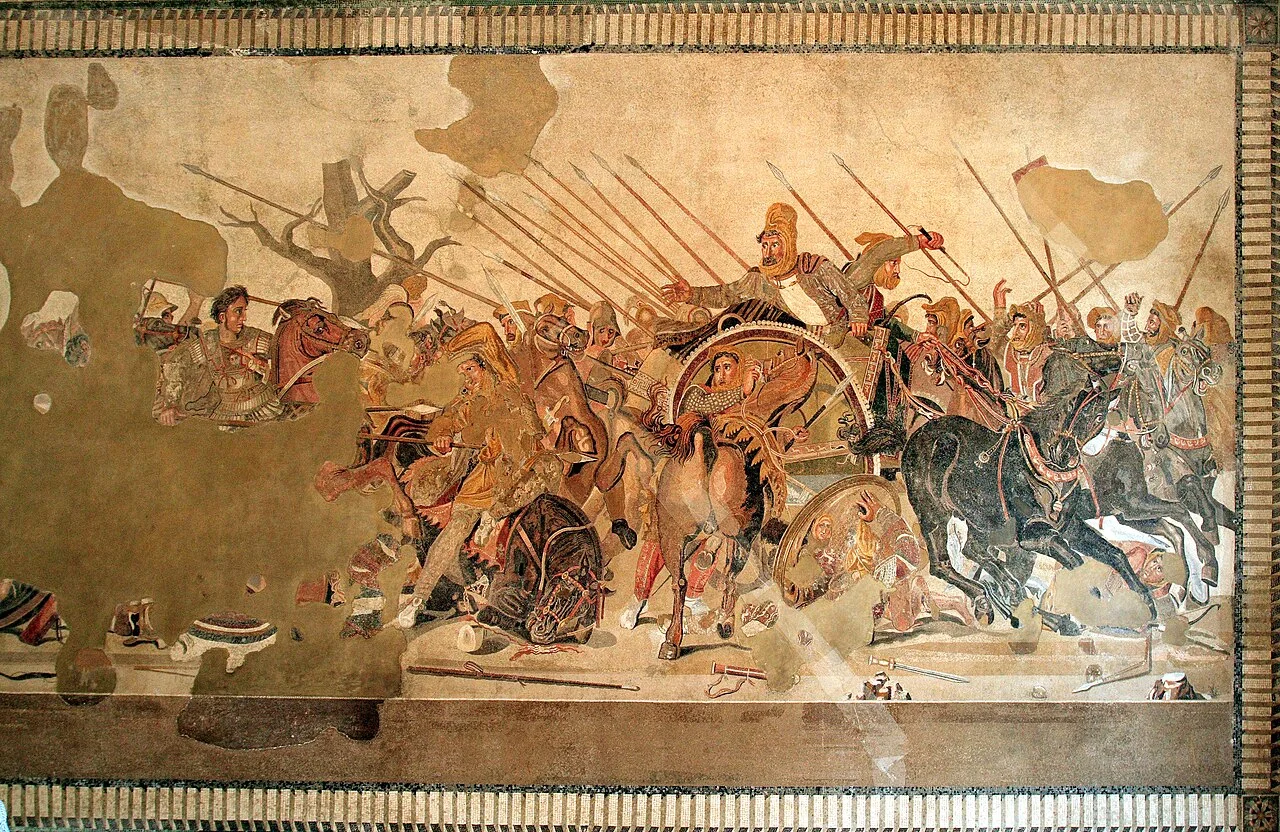
The Alexander Mosaic depicting Alexander the Great and Darius III in battle, displayed in Naples.View image
Ancient artwork photograph

How did a once-famous royal tomb lose its location?

From 323 BCE

The story

What we know

Alexander died at Babylon in 323 BCE. His preserved body became a political prize and ultimately rested at Alexandria. Its presence helped link Egypt’s Ptolemaic rulers to the conqueror. The puzzle is how a burial once described and visited became a monument without a securely identified modern location. [1] [2] [3]

More context & timeline

Ancient accounts place Alexander’s burial within Alexandria’s royal setting, alongside the Ptolemaic dynasty. They disagree about parts of its earlier journey. Written testimony establishes a history of the tomb, but it does not supply a surviving surveyed plan that can simply be laid over the modern city. [1] [2] [3]
  1. 323 BCE

    Alexander dies in Babylon; his body becomes central to succession politics. [1]

  2. Early Ptolemaic period

    His body reaches Alexandria; the transfer’s precise sequence is disputed. [1]

  3. Roman period

    Literary accounts describe visits to the burial, including that of Augustus. [1]

Look closely

Follow the evidence

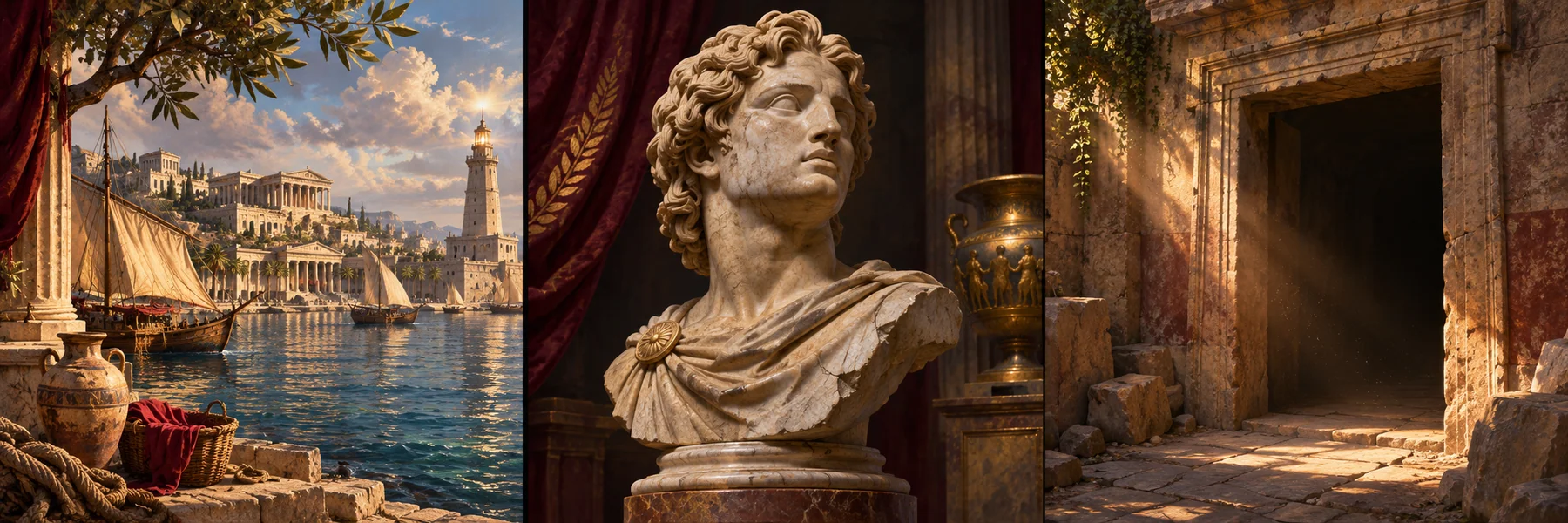
Imagined historical illustrations. The tomb’s appearance and exact site are unknown; these scenes are not archaeological reconstructions or pictures of a discovered grave.

AI-generated editorial illustration: An imagined Hellenistic Mediterranean harbor
AI illustration · imagined scene
Evidence 1

A place within the royal city

Strabo places the burial in an enclosure associated with the palaces and royal tombs. This provides a broad historical setting, not a modern street address. [2]

AI-generated editorial illustration: A conceptual Hellenistic portrait bust
AI illustration · imagined scene
Evidence 2

A visit with different versions

Suetonius and Cassius Dio describe Augustus encountering Alexander’s body. Their differing emphases remind us that ancient visits reach us through literary accounts with their own purposes. [1]

AI-generated editorial illustration: An empty symbolic stone doorway
AI illustration · imagined scene
Evidence 3

Rhetoric is not a destruction report

Later Christian writers invoke the obscurity of Alexander’s grave. Historian Andrew Erskine cautions that this cannot establish what Alexandrians knew or when the tomb disappeared. [1]

Interpret the evidence

What could explain it?

Follow a possibility. Weigh what supports it. See where the evidence stops.

AI artwork sets the scene; it does not reconstruct an established answer.

Explore an explanationRemains survive but are unidentified

The support

Ancient topography gives researchers an Alexandrian royal setting to investigate. [2]

The limit

No surviving feature has been securely matched to the tomb. A broad setting is not a discovery. [2]

Explore an explanationThe monument was destroyed or dismantled

The support

Some scholars connect its loss with later urban upheavals, including disturbances in 272 CE. [1]

The limit

Erskine warns that the cited literary rhetoric cannot prove that outcome or date. [1]

Explore an explanationThe body was moved or its setting changed

The support

Ancient sources already describe transfers and a replacement of the original gold coffin. [2]

The limit

Those interventions do not establish a later final transfer or identify remains elsewhere. [2]

What would connect an excavated structure to one named individual rather than to royalty generally?
The Alexander Mosaic depicting Alexander the Great and Darius III in battle, displayed in Naples.
Ancient artwork photograph

Connected place

Alexandria National Museum

A public museum for exploring the city’s wider archaeological and historical setting.

Visitor guide

This is a context stop, not the tomb or evidence of its location. Check official information for current access and exhibitions.

AI-generated editorial illustration: An empty symbolic stone doorway
AI illustration · imagined scene

Keep investigating

Step beyond the story.

Explore the connected place, examine the records, and form your own reading of the evidence.

Photo credits & full-image view
The ancient Alexander Mosaic from Pompeii, photographed in Naples’s National Archaeological Museum. Context for Alexander, not his tomb.

Magrippa / Wikimedia Commons · Image source · CC BY-SA 3.0

Resized without enlargement and converted to WebP; orientation follows source metadata. No manual crop or content alteration. The complete downloaded frame is preserved; card or banner display crops may be used. Image derivatives retain the stated image rights or license.

Scene artwork is AI-generated editorial illustration. Real photographs and original records retain their separate credits.

Sources & further reading

Original TrekBoundX writing. Research reviewed November 24, 2026. Source links do not imply institutional endorsement.

  1. Andrew Erskine / University of EdinburghLife after death: Alexandria and the body of Alexander (2002)Examine the source
  2. Strabo / UChicago LacusCurtiusGeography XVII.1.8: Alexandria’s royal precinct and burialExamine the source
  3. University College London, Digital EgyptAlexander the Great: chronology and burial contextExamine the source
  4. Egyptian Ministry of Tourism and AntiquitiesAlexandria National MuseumExamine the source
Suggest a correction
All mysteriesNext mysteryThe Sanxingdui Pits

Alexander’s Missing Tomb — image

The Alexander Mosaic depicting Alexander the Great and Darius III in battle, displayed in Naples.
The ancient Alexander Mosaic from Pompeii, photographed in Naples’s National Archaeological Museum. Context for Alexander, not his tomb.

Magrippa / Wikimedia Commons · Image source · CC BY-SA 3.0

Resized without enlargement and converted to WebP; orientation follows source metadata. No manual crop or content alteration. The complete downloaded frame is preserved; card or banner display crops may be used. Image derivatives retain the stated image rights or license.