
All mysteries

Ancient worlds

The Sanxingdui Pits

0 of 3 evidence items examined
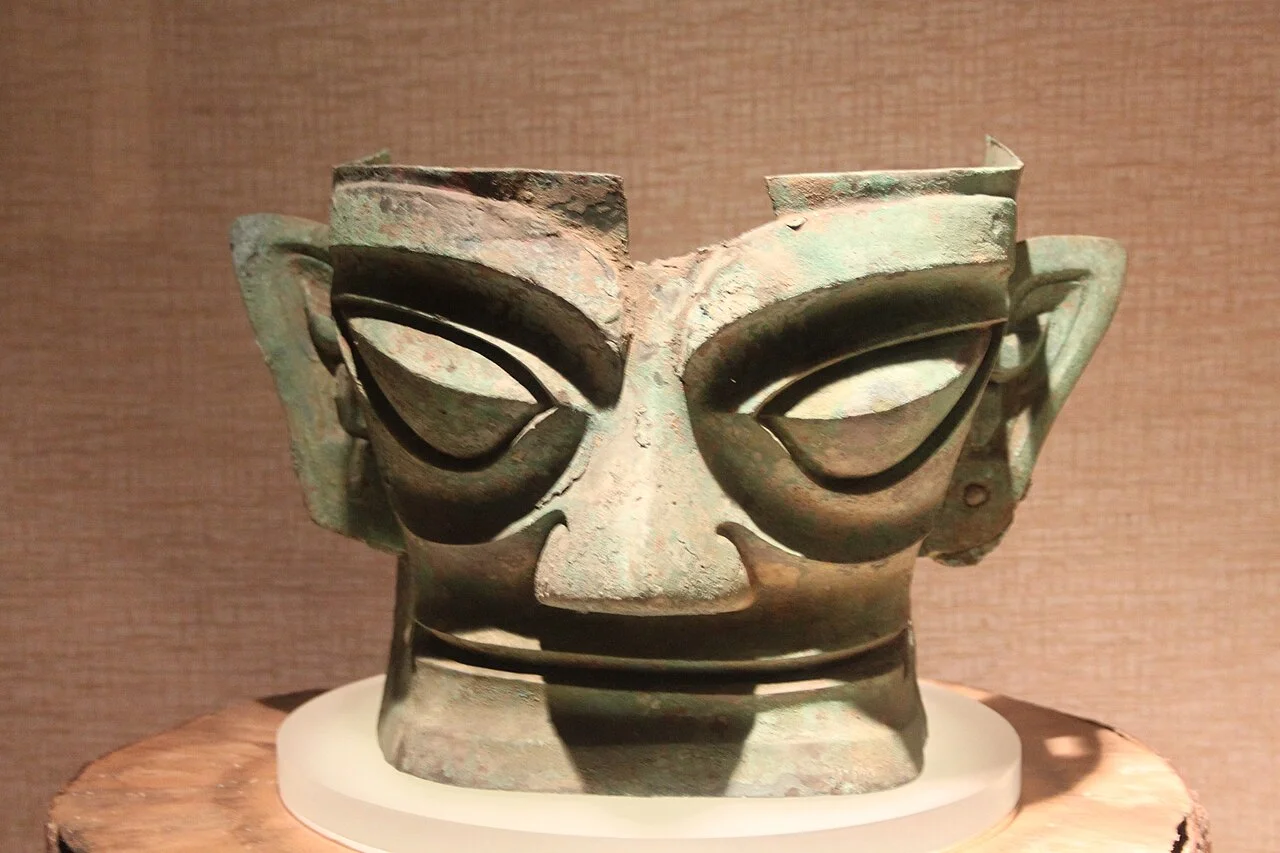
An ancient Sanxingdui bronze mask on display in the museum.View image
Original object photograph

Why were magnificent objects broken, burned and buried?

Late second millennium BCE

The story

What we know

Ancient Shu communities in Sichuan made some of the most striking objects of the Bronze Age. Archaeologists found them in pits containing layered deposits of bronze, gold, jade and ivory. The question concerns what people did with these objects, and why they placed them underground. [1] [2] [3]

More context & timeline

Two pits discovered in 1986 were followed by six more identified in 2019. New excavation and laboratory methods recover evidence that earlier investigations could not easily preserve, including textiles. These are deposits of objects; their usual description as sacrificial pits is an interpretation of their purpose. [1] [2] [3]
  1. Late Shang period

    Objects and textiles belong to an ancient Shu ritual landscape. [3]

  2. 1986

    The first two major pits transform knowledge of the site. [1]

  3. 2019–2022

    Six more pits are identified and systematically excavated. [2]

Look closely

Follow the evidence

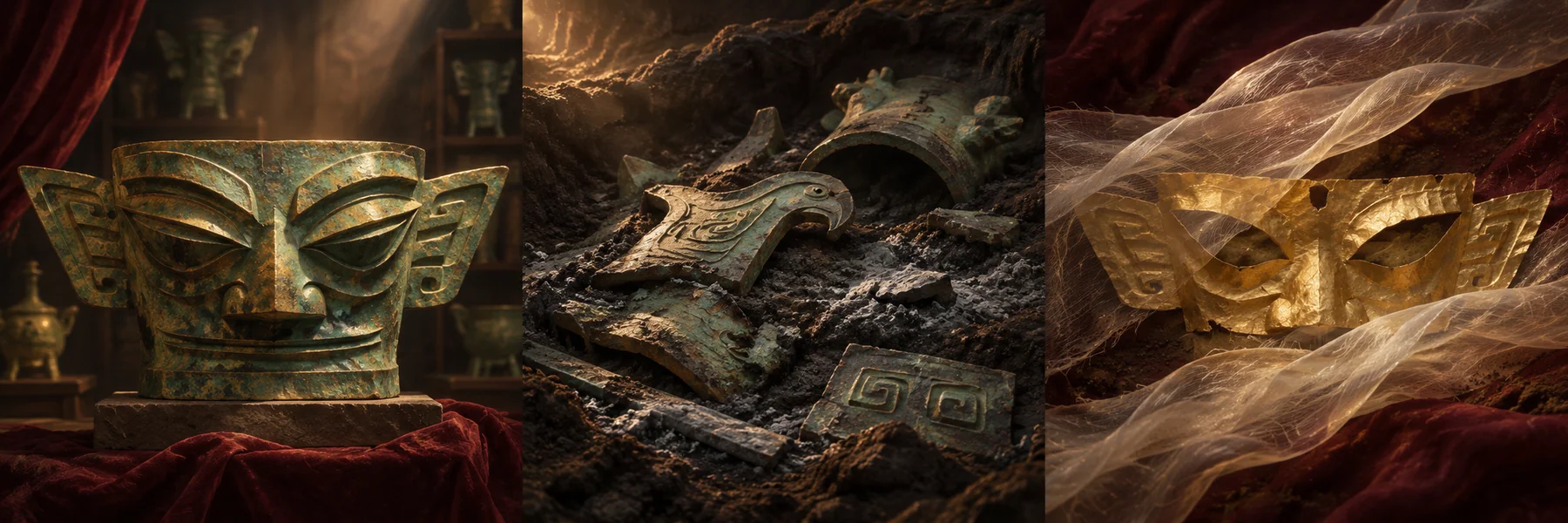
Illustrations imagine human activities around the evidence. They do not reconstruct a documented ceremony or establish the masks’ identities.

AI-generated editorial illustration: An ancient-Shu-inspired imagined bronze mask
AI illustration · imagined scene
Evidence 1

An arrangement underground

The objects occur in layers rather than a simple scatter. Breakage and burning recur, but neither action tells us by itself whether a ceremony, accident or conflict caused it. [2]

AI-generated editorial illustration: Imagined layered ceremonial fragments in soil
AI illustration · imagined scene
Evidence 2

Fire outside the pit

A study of Pit K4 found dumping profiles and no corresponding intense heating of its walls or floor. Its combustion residues were carried in from a fire elsewhere. [2]

AI-generated editorial illustration: A conceptual gold mask and textile fibers
AI illustration · imagined scene
Evidence 3

Cloth that almost disappeared

Silk residues survive against bronze, gold, jade and ivory. Their positions suggest that cloth covered, wrapped or cushioned objects, or formed offerings in its own right. [3]

Interpret the evidence

What could explain it?

Follow a possibility. Weigh what supports it. See where the evidence stops.

AI artwork sets the scene; it does not reconstruct an established answer.

Explore an explanationCeremonial burial after burning

The support

Ordered deposition and externally produced ash support deliberate burial of ritual material. [2]

The limit

They do not identify the ceremony, its participants or its intended recipient. [2]

Explore an explanationDisposal after damage or disruption

The support

Researchers have considered whether damaged ritual equipment was collected and buried. [2]

The limit

Breakage alone cannot distinguish warfare or an accident from deliberate ceremonial destruction. [2]

Explore an explanationOfferings made from several materials

The support

The arrangement of silk with other objects suggests that textiles participated in the same activities. [3]

The limit

We cannot yet separate practical wrapping from symbolic offering in every example. [3]

How might finding perishable cloth change an explanation built only around surviving metal?
An ancient Sanxingdui bronze mask on display in the museum.
Original object photograph

Connected place

Sanxingdui Museum

A public learning destination beside the archaeological site in Guanghan.

Visitor guide

Check official visitor channels for arrangements. Conservation, loans and changing displays mean that no particular object is promised on view.

AI-generated editorial illustration: A conceptual gold mask and textile fibers
AI illustration · imagined scene

Keep investigating

Step beyond the story.

Explore the connected place, examine the records, and form your own reading of the evidence.

Photo credits & full-image view
An ancient bronze mask photographed at Sanxingdui Museum in 2010.

Gary Todd · Image source · CC0 1.0

Resized without enlargement and converted to WebP; orientation follows source metadata. No manual crop or content alteration. The complete downloaded frame is preserved; card or banner display crops may be used. Image derivatives retain the stated image rights or license.

Scene artwork is AI-generated editorial illustration. Real photographs and original records retain their separate credits.

Sources & further reading

Original TrekBoundX writing. Research reviewed November 24, 2026. Source links do not imply institutional endorsement.

  1. Li and colleagues, Sichuan University / AntiquityNew discoveries at the Sanxingdui Bronze Age site in south-west ChinaExamine the source
  2. Zhang and colleagues / Journal of Archaeological ScienceSacrificial pit or not? Deposition history of Pit K4 (2026)Examine the source
  3. Guo and colleagues / AntiquitySilk and sacrifice at Sanxingdui (2026)Examine the source
  4. Sanxingdui MuseumOfficial museum websiteExamine the source
Suggest a correction
All mysteriesNext mysteryThe Roman Dodecahedra

The Sanxingdui Pits — image

An ancient Sanxingdui bronze mask on display in the museum.
An ancient bronze mask photographed at Sanxingdui Museum in 2010.

Gary Todd · Image source · CC0 1.0

Resized without enlargement and converted to WebP; orientation follows source metadata. No manual crop or content alteration. The complete downloaded frame is preserved; card or banner display crops may be used. Image derivatives retain the stated image rights or license.