
All mysteries

Lost treasures

The Lost Amber Room

0 of 3 evidence items examined
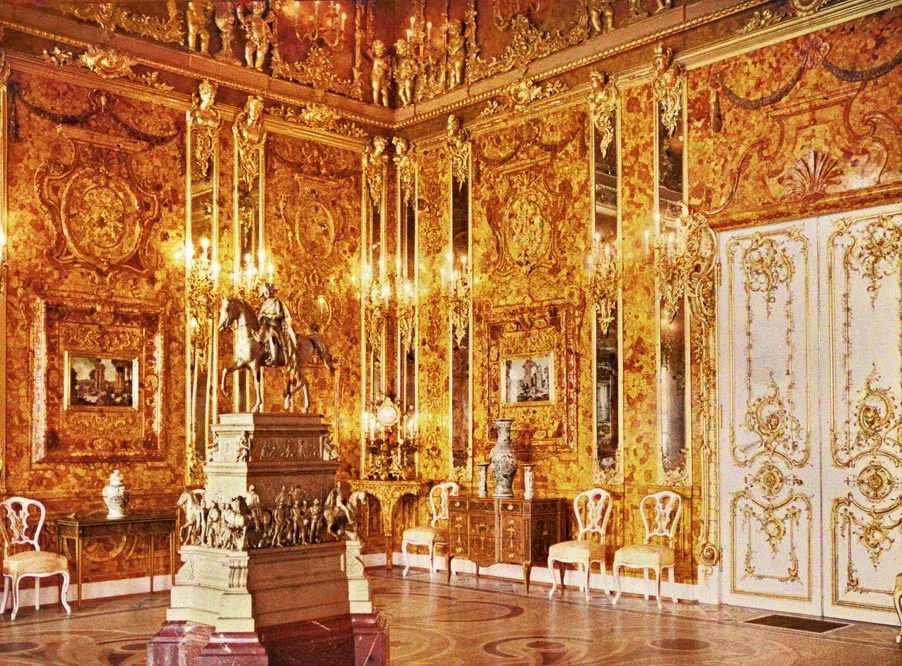
An early color autochrome showing the original Amber Room’s amber wall panels and furnishings before its wartime loss.View image
Archival photograph

What happened to the original room after it was stolen?

1716–1945; reconstruction completed in 2003

The story

What we know

The Amber Room was an interior assembled from decorated panels, mirrors and elaborate furnishings. Nazi specialists removed its amber panels from Catherine Palace in 1941 and sent them to Königsberg. The room visitors encounter at Catherine Palace today is a reconstruction, not the recovered original. [1] [2]

More context & timeline

Prussian amber panels given to Peter I in 1716 eventually became part of a much larger Russian palace interior. The stolen panels were displayed at Königsberg Castle. Accounts differ over their final wartime movements; the complete original ensemble has never been recovered. [1] [2]
  1. 1716–1755

    Panels given to Peter I are eventually moved to Catherine Palace. [1]

  2. 1941–1945

    Nazi looting takes the panels to Königsberg; the final trail becomes uncertain. [2]

  3. 1979–2003

    A reconstruction project recreates the room, opening to visitors in 2003. [2]

Look closely

Follow the evidence

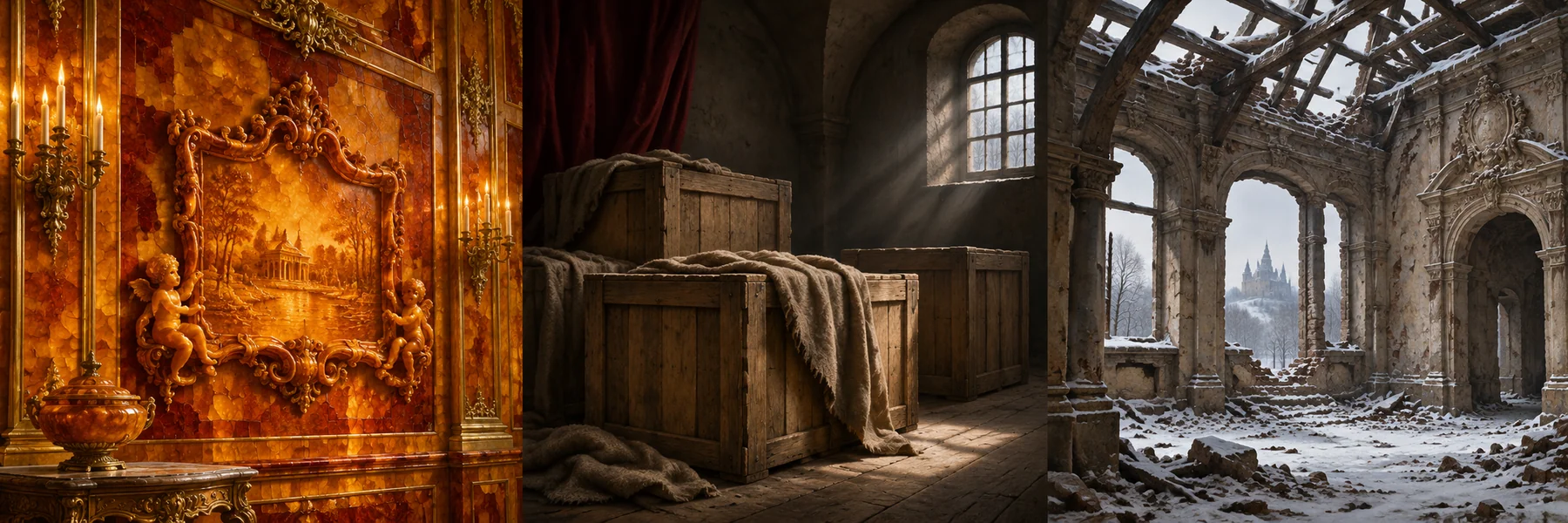
These are imagined historical illustrations. The crate scene does not document the panels’ final journey; modern interior images must be labeled as the reconstruction.

AI-generated editorial illustration: Imagined glowing amber ornament
AI illustration · imagined scene
Evidence 1

A documented stop

Museum records place the stolen panels at Königsberg Castle, where they were exhibited. That anchors part of the journey, without establishing what happened to every component afterward. [1]

AI-generated editorial illustration: Imagined wartime packing crates
AI illustration · imagined scene
Evidence 2

Packing and broken mosaics

Correspondence describes preparations to pack and evacuate the panels. Fragments of three Florentine mosaics were later found in the castle ruins: evidence of destruction, but not a complete inventory. [2]

AI-generated editorial illustration: A conceptual ruined castle interior
AI illustration · imagined scene
Evidence 3

Original pieces came back

An original mosaic, Touch and Smell, and a marquetry chest returned to the museum in 2000. Their survival shows that individual pieces followed different paths. [1]

Interpret the evidence

What could explain it?

Follow a possibility. Weigh what supports it. See where the evidence stops.

AI artwork sets the scene; it does not reconstruct an established answer.

Explore an explanationDestruction in wartime

The support

The devastated castle and mosaic fragments support the possibility that substantial parts were destroyed. [2]

The limit

Those remains do not establish the fate of every amber panel. [2]

Explore an explanationEvacuation and concealment

The support

The museum’s account of wartime dismantling and dispatch leaves open the possibility that material left Königsberg. [1]

The limit

No authenticated discovery has located the complete missing ensemble. [1]

Explore an explanationAn ensemble scattered into pieces

The support

Recovered original furnishings demonstrate that some components survived separately. [2]

The limit

Partial dispersal could accompany destruction or evacuation; it does not locate the remaining panels. [2]

Would finding one genuine fragment prove that the rest of the room survived?
An early color autochrome showing the original Amber Room’s amber wall panels and furnishings before its wartime loss.
Archival photograph

Connected place

Catherine Palace / Tsarskoe Selo

The historic setting of the original and the home of its modern reconstruction.

Visitor guide

The present Amber Room is reconstructed. Check the museum for current arrangements; this link is not a location for the missing original.

AI-generated editorial illustration: A conceptual ruined castle interior
AI illustration · imagined scene

Keep investigating

Step beyond the story.

Explore the connected place, examine the records, and form your own reading of the evidence.

Photo credits & full-image view
The original Amber Room at Catherine Palace in a 1917 autochrome by Andrey Zeest.

Andrey Andreyevich Zeest · Image source · Public domain (Commons PD-RusEmpire and U.S. expired-copyright record)

Resized without enlargement and converted to WebP; orientation follows source metadata. No manual crop or content alteration. The complete downloaded frame is preserved; card or banner display crops may be used. Image derivatives retain the stated image rights or license.

Scene artwork is AI-generated editorial illustration. Real photographs and original records retain their separate credits.

Sources & further reading

Original TrekBoundX writing. Research reviewed November 24, 2026. Source links do not imply institutional endorsement.

  1. Tsarskoe Selo State Museum and Heritage SiteAmber Room: history, wartime loss and recreationExamine the source
  2. GIA, Gems & GemologyThe History and Reconstruction of the Amber Room (2018)Examine the source
  3. Tsarskoe Selo State Museum and Heritage SiteVisit plannerExamine the source
Suggest a correction
All mysteriesNext mysteryThe Princes in the Tower

The Lost Amber Room — image

An early color autochrome showing the original Amber Room’s amber wall panels and furnishings before its wartime loss.
The original Amber Room at Catherine Palace in a 1917 autochrome by Andrey Zeest.

Andrey Andreyevich Zeest · Image source · Public domain (Commons PD-RusEmpire and U.S. expired-copyright record)

Resized without enlargement and converted to WebP; orientation follows source metadata. No manual crop or content alteration. The complete downloaded frame is preserved; card or banner display crops may be used. Image derivatives retain the stated image rights or license.