How did ancient makers fit the movements of the heavens into a machine?
About 150–100 BCE
The story
What we know
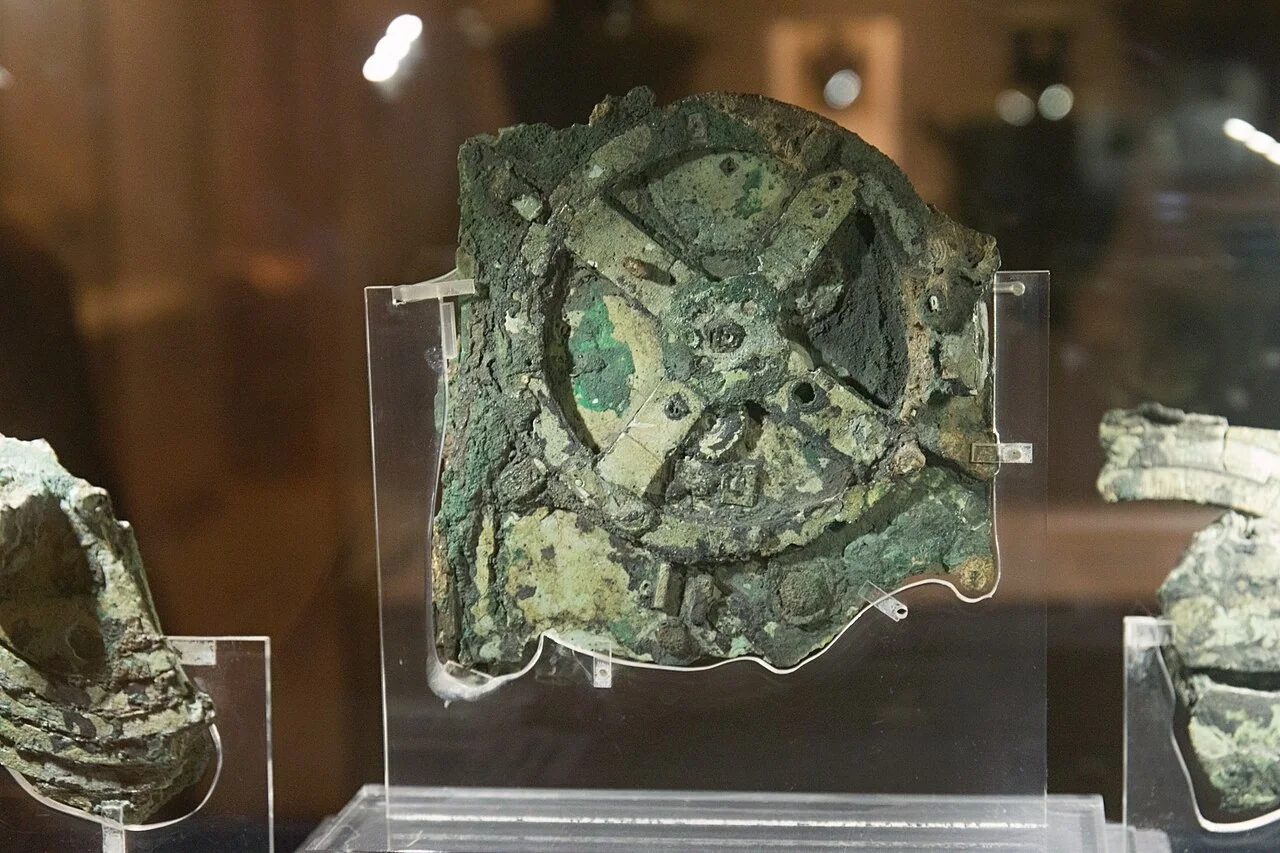
Small fragments from an ancient shipwreck changed what researchers could demonstrate about Greek mechanical astronomy. Gears and inscriptions show a device that calculated celestial cycles. Its mystery lies in the missing parts, maker, and history—not in whether ancient people could build it. [1][2]
More context & timeline
The Greek Ministry of Culture dates the mechanism to about 150–100 BCE. Recovered from the Antikythera wreck in 1900–1901, its surviving components identify an astronomical and calendar calculator. It belongs within ancient Greek mathematical and technical knowledge. [1][2]
About 150–100 BCE
The mechanism is made, according to the museum’s dating. [1]
1900–1901
Divers recover material from the Antikythera shipwreck. [1]
Modern research
Imaging reveals hidden gears and inscriptions; researchers test reconstructions. [3]
Look closely
Follow the evidence
Conceptual gears, inscriptions and imaging—not actual fragments, X-ray data or a proven reconstruction.
Gear ratios encode repeating astronomical cycles. They connect physical tooth counts to calculations involving the sun, moon, and eclipses. [1]
AI illustration · imagined scene
Evidence 2
Instructions survive
Greek inscriptions help researchers identify calculations and operating information. The device carried evidence of its own use. [1]
AI illustration · imagined scene
Evidence 3
A view inside the fragments
X-ray tomography reveals structure concealed by corrosion. Only roughly a third of the original survives, leaving major constraints and major gaps. [3]
1 / 3
Interpret the evidence
What could explain it?
Follow a possibility. Weigh what supports it. See where the evidence stops.
AI artwork sets the scene; it does not reconstruct an established answer.
AIExplore an explanationAn astronomical calendar calculator
The support
Surviving gears and inscriptions strongly support solar, lunar, and eclipse-related functions. [1]
The limit
This established purpose does not recover every missing component. [1]
AIExplore an explanationA fuller planetary display
The support
Inscriptions support a display involving planets known to ancient Greek astronomers. A 2021 research model proposes a gear arrangement. [3]
The limit
A reconstruction must fit limited surviving space and evidence; the complete original arrangement remains open. [3]
AIExplore an explanationEarlier identification as a navigation instrument
The support
Early investigators compared the fragments with familiar astronomical instruments. [2]
The limit
These proposals belong to the history of research, rather than standing as equally supported alternatives today. [2]
Which parts of a reconstruction are compelled by surviving evidence, and which are choices made to fill a gap?
Related place or object
Connected place
National Archaeological Museum of Athens
The museum holds the original fragments; it is not the shipwreck site.
Resized and converted to WebP. Cards and banners show display crops; the expanded image preserves the complete downloaded frame. Adapted images retain the stated image license.
Scene artwork is AI-generated editorial illustration. Real photographs and original records retain their separate credits.
Sources & further reading
Original TrekBoundX writing. Research reviewed November 23, 2026. Source links do not imply institutional endorsement.