
All mysteries

Reports and perception · Documented history

The Battle of Los Angeles

0 of 3 evidence items examined
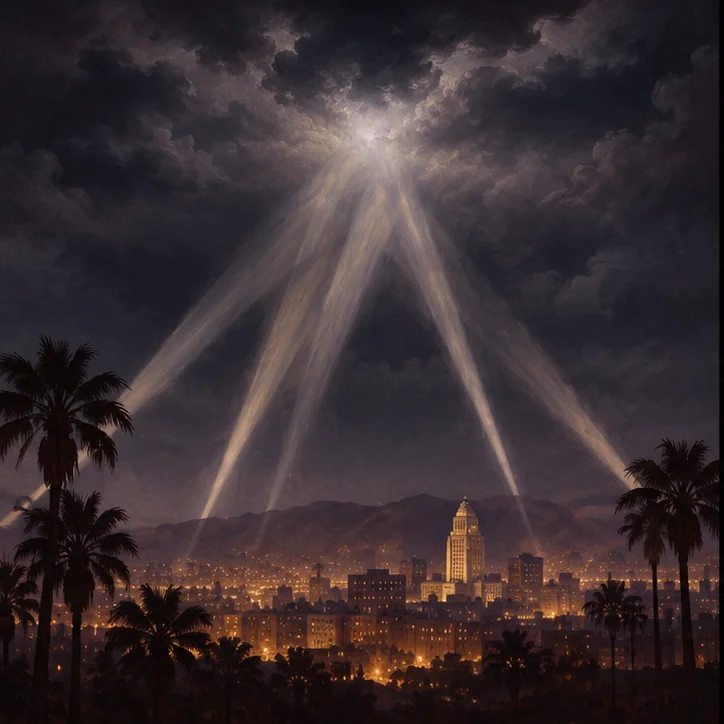
AI-generated editorial illustration: Searchlights cross in an empty cloudy sky.View image
AI illustration · imagined scene

How did an uncertain alarm become a battle over a city?

February 1942

The story

What we know

Air-raid alarms and antiaircraft firing disrupted Los Angeles on 24–25 February 1942. The United States had recently entered the war, and a Japanese submarine had shelled California two nights earlier. Defenders had reason to expect danger when ambiguous reports arrived. [1] [2]

More context & timeline

Official histories describe conflicting reports and explanations rather than a verified Japanese raid. Army and Navy assessments initially differed. Later historical analysis emphasised balloons, misidentification, and the way gunfire and searchlights could create additional apparent targets. An unidentified light does not automatically identify an aircraft, much less an extraordinary craft. [1] [2]

  1. 23 February 1942

    A Japanese submarine shells coastal installations near Santa Barbara, heightening concern. [1]

  2. 24–25 February 1942

    Alerts, searchlights, and extensive firing occur over the Los Angeles area. [2]

  3. Afterward

    Officials and later military historians examine inconsistent reports and the absence of a confirmed hostile raid. [1]
Look closely

Follow the evidence

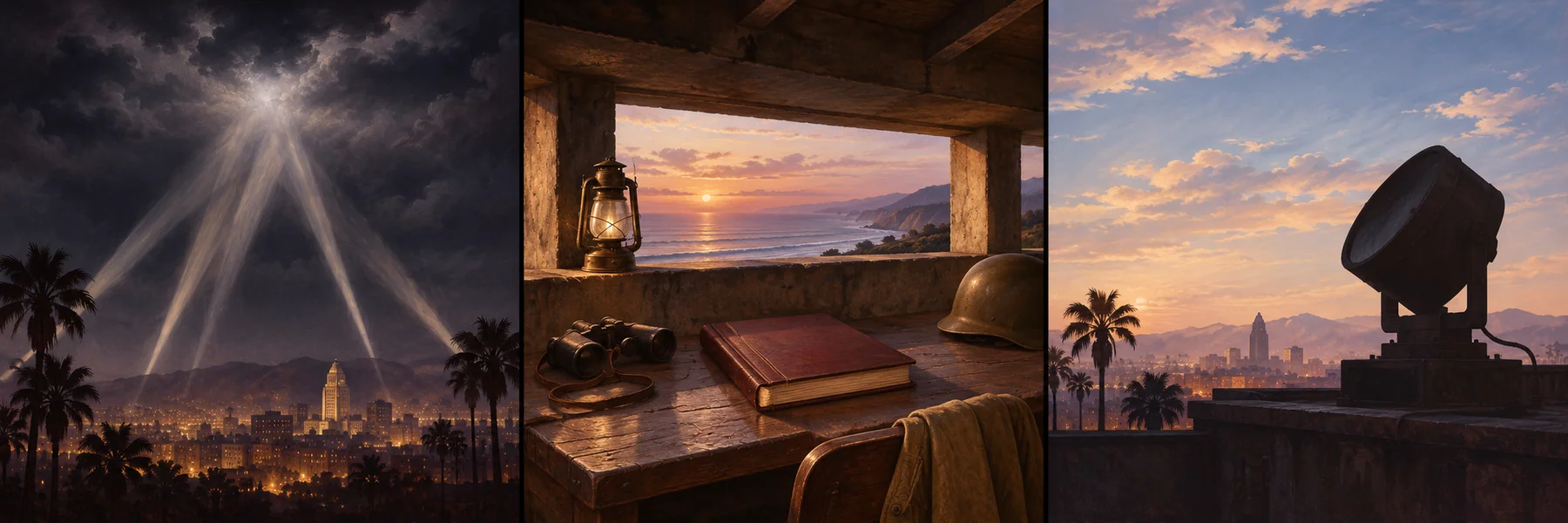
Imagined civil-defence scenes, not a reconstruction of the famous edited press photograph. No unidentified craft or hostile aircraft is asserted.

AI-generated editorial illustration: Searchlights cross in an empty cloudy sky.
AI illustration · imagined scene
Evidence 1

The preceding attack was real

The submarine shelling explains why defenders expected danger. It supplies historical context for the alarm, not proof that the next night’s supposed aircraft were genuine. [1]

AI-generated editorial illustration: A quiet coastal observation shelter at dawn.
AI illustration · imagined scene
Evidence 2

Reports did not form one clear picture

Accounts varied in the numbers and descriptions of objects. Such inconsistency matters when a modern retelling compresses all witnesses into a single sighting. [2]

AI-generated editorial illustration: An anonymous rooftop beneath a clearing sky.
AI illustration · imagined scene
Evidence 3

The response could generate new stimuli

Official historical analysis considered balloons and illuminated shell bursts as things observers could interpret as aircraft. The growing barrage could therefore amplify the uncertainty that started it. [2]

Interpret the evidence

Fact, record and legend

Follow a possibility. Weigh what supports it. See where the evidence stops.

AI artwork sets the scene; it does not reconstruct an established answer.

Explore an explanationMisidentified objects during a wartime scare

The support

Balloons and ambiguous observations offer an explanation consistent with official historical analysis and the heightened expectations of defenders. [2]

The limit

This does not positively identify every reported light or prove each witness saw the same thing. A general explanation must retain those limits. [2]

Explore an explanationA self-amplifying defensive response

The support

Searchlights, bursts, reports from nearby units, and expectations of attack could encourage further firing and further perceived targets. [1]

The limit

The feedback interpretation explains escalation, not necessarily the first stimulus. Uncertainty about that initial moment does not establish a hidden enemy or unknown technology. [1]

When everybody expects a threat, how can a system check whether its own response is creating new alarms?
AI-generated editorial illustration: Searchlights cross in an empty cloudy sky.
AI illustration · imagined scene

Connected place

National Museum of the United States Air Force

A public museum for military aviation and air-defence history.

Visitor guide

Use the official museum information for aviation context. This is not the location of the Los Angeles event or a promise that a particular exhibit is available.

AI-generated editorial illustration: An anonymous rooftop beneath a clearing sky.
AI illustration · imagined scene

Keep investigating

Step beyond the story.

Explore the connected place, examine the records, and form your own reading of the evidence.

Photo credits & full-image view
AI-generated editorial illustration for The Battle of Los Angeles. It is an imagined scene, not a historical photograph or source evidence.

Created for TrekboundX · Image source · AI artwork details

Left panel extracted from a generated triptych and optimized as WebP without enlargement. The original PNG and generation prompt are preserved in the project artwork ledger.

Scene artwork is AI-generated editorial illustration. Real photographs and original records retain their separate credits.

Sources & further reading

Original TrekBoundX writing. Research reviewed November 25, 2026. Source links do not imply institutional endorsement.

  1. U.S. Army Center of Military HistoryGuarding the United States and Its OutpostsExamine the source
  2. Office of Air Force History / Museum of the City of San Francisco transcriptionThe Army Air Forces in World War II: The Battle of Los AngelesExamine the source
  3. National Museum of the United States Air ForceOfficial museum websiteExamine the source
Suggest a correction
All mysteriesNext mysteryMachu Picchu: The People Behind the Stonework

The Battle of Los Angeles — image

AI-generated editorial illustration: Searchlights cross in an empty cloudy sky.
AI-generated editorial illustration for The Battle of Los Angeles. It is an imagined scene, not a historical photograph or source evidence.

Created for TrekboundX · Image source · AI artwork details

Left panel extracted from a generated triptych and optimized as WebP without enlargement. The original PNG and generation prompt are preserved in the project artwork ledger.