What can a found wreck add to the diaries of the people who watched their ship disappear?
1915–2022
The story
What we know
Shackleton’s ship became trapped in Weddell Sea ice in 1915. The crew abandoned it on October 27; it sank on November 21. The twenty-eight members of the Endurance party eventually survived after an extraordinary sequence of camps, boat journeys and rescue attempts. Their ship remained unseen until the Endurance22 expedition located it on March 5, 2022. [1][2]
More context & timeline
The discovery team found the wreck approximately four miles south of Captain Frank Worsley’s recorded position, at a depth of 3,008 metres. Survey images showed a remarkably preserved vessel. The expedition’s discovery announcement and later conservation planning make its status clear: this is a found, protected wreck, not a ship still awaiting identification. [1][2]
October 27–November 21, 1915
The crew abandons the damaged ship; it later sinks. [2]
March 5, 2022
Endurance22 locates the wreck in the Weddell Sea. [1]
2024
A conservation management plan addresses its long-term protection. [2]
Look closely
Follow the evidence
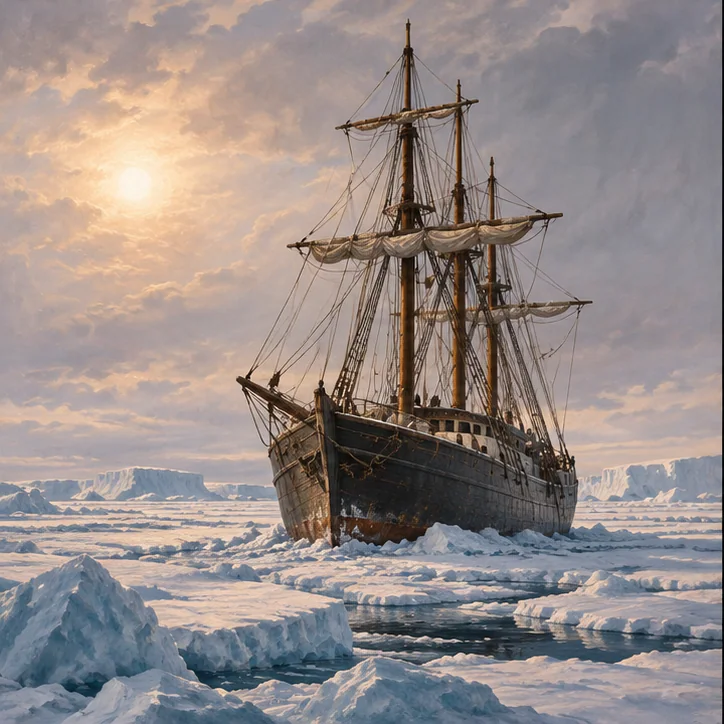
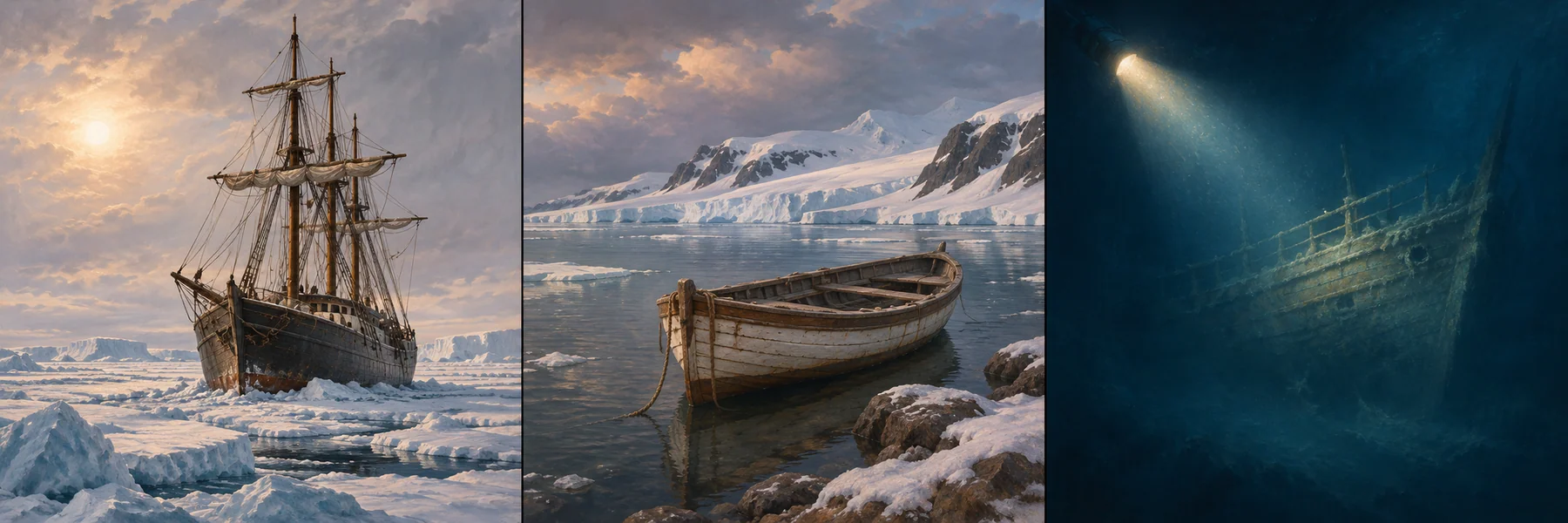
These illustrations evoke the expedition and modern survey; Endurance’s wreck was found in 2022, and the scenes are not documentary wreck imagery.
AI illustration · imagined scene
Evidence 1
A position close enough to matter
Worsley’s recorded sinking position substantially constrained the search, despite a difference of several miles from the eventual find. An imperfect historical measurement can still be invaluable when its uncertainty is understood. [1]
AI illustration · imagined scene
Evidence 2
A ship seen from two periods
A recent technical study compares diaries and memoirs with ship construction and wreck observations. The records describe repeated ice-pressure events, rather than a vessel failing without warning in ordinary open water. [3]
AI illustration · imagined scene
Evidence 3
Abandonment and sinking were separate events
The management plan distinguishes the October abandonment from the November sinking. Combining them into one date changes the survival chronology and obscures the weeks during which the crew watched the damaged ship from the ice. [2]
1 / 3
Interpret the evidence
Fact, record and legend
Follow a possibility. Weigh what supports it. See where the evidence stops.
AI artwork sets the scene; it does not reconstruct an established answer.
AIExplore an explanationIce pressure overwhelmed the hull
The support
Contemporary accounts and engineering analysis support damage caused by Antarctic sea ice. [3]
The limit
The broad cause is established; reconstructing the exact loads and sequence of structural failure is a more demanding question. [3]
AIExplore an explanationA difficult search rather than an unknowable disappearance
The support
Sea ice, remoteness and deep water limited access until a specialised expedition could survey the search area. [1]
The limit
The successful search does not make the site easy to reach or justify disturbance of its remains. [1]
AIExplore an explanationA new archaeological chapter
The support
The wreck can be compared with documents to test details of construction, damage and shipboard life. [2]
The limit
Its research value depends on conserving context; an attractive loose object is not automatically more informative after removal. [2]
Once a wreck has been found, which questions require physical intervention, and which could be answered through careful imaging and the existing archive?
AI illustration · imagined scene
Connected place
The Polar Museum, University of Cambridge
The museum connects polar exploration with surviving objects and archival research.
Left panel extracted from a generated triptych and optimized as WebP without enlargement. The original PNG and generation prompt are preserved in the project artwork ledger.
Scene artwork is AI-generated editorial illustration. Real photographs and original records retain their separate credits.
Sources & further reading
Original TrekBoundX writing. Research reviewed November 25, 2026. Source links do not imply institutional endorsement.