Why does extensive footage of a disaster still leave its first moment uncertain?
1937 and later research
The story
What we know
On 6 May 1937, the Hindenburg caught fire at Lakehurst. Thirty-six people died, including one on the ground. Film, photographs, broadcasts, testimony, and investigation created a vivid record without completely capturing the initiating event. [1][2][4]
More context & timeline
The airship carried hydrogen, a flammable lifting gas. Investigators and later researchers have considered how a leak, weather, electrical conditions, and the outer covering might relate to ignition and fire spread. These are connected but separate issues. A material that burns during a disaster is not automatically the material that first ignited. [1][2][4]
6 May 1937
The Hindenburg burns while approaching its mooring at Lakehurst. [1]
1937
The U.S. Department of Commerce conducts an extensive accident investigation. [3]
Later research
Specialists revisit ignition and fire-spread proposals using the historical record and material analysis. [2]
Look closely
Follow the evidence
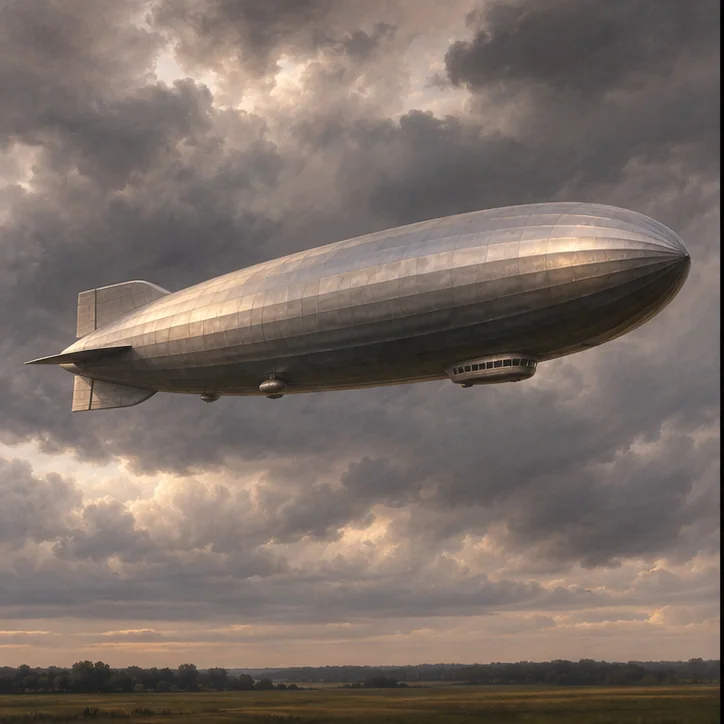
Imagined airship-history scenes. They do not reconstruct ignition, show casualties, or turn a disputed ignition hypothesis into an observed fact.
AI illustration · imagined scene
Evidence 1
The camera arrived too late for one question
Surviving film shows the burning airship, but not the actual instant of ignition. The most familiar evidence therefore cannot directly show what first started the fire. [1]
AI illustration · imagined scene
Evidence 2
Witnesses saw different parts of the event
Accounts differ about where flames first appeared. Position, timing, and what was visible matter when comparing descriptions of a rapidly developing fire. [1]
AI illustration · imagined scene
Evidence 3
Chemistry can test a proposal
Analysis of hydrogen and covering materials helps assess whether a proposed ignition or fire-spread explanation is physically plausible. Plausibility still has to fit the observed sequence. [2]
1 / 3
Interpret the evidence
Fact, record and legend
Follow a possibility. Weigh what supports it. See where the evidence stops.
AI artwork sets the scene; it does not reconstruct an established answer.
AIExplore an explanationHydrogen ignited under electrical conditions
The support
A hydrogen leak followed by an electrical discharge is a prominent explanation examined in scientific discussion of the disaster. [2]
The limit
The exact leak and ignition event were not directly observed and conclusively reconstructed. A likely mechanism is not a recovered recording of that moment. [2]
AIExplore an explanationThe outer covering played a decisive role
The support
A competing proposal emphasises the flammability of the airship’s covering and its possible contribution to the fire. [2]
The limit
The covering burning does not establish that it initiated the disaster. Chemical and timing arguments challenge versions that minimise the role of hydrogen. [2]
If every photograph begins after an event starts, which questions can photography never answer directly?
AI illustration · imagined scene
Connected place
National Air and Space Museum
A public institution preserving airship history and related archival material.
Consult current museum information. This case does not promise access to Lakehurst facilities, a particular surviving fragment, or an original investigation volume without arrangements.
AI illustration · imagined scene
Keep investigating
Step beyond the story.
Explore the connected place, examine the records, and form your own reading of the evidence.
Photo credits & full-image view
AI-generated editorial illustration for The Hindenburg disaster. It is an imagined scene, not a historical photograph or source evidence.
Left panel extracted from a generated triptych and optimized as WebP without enlargement. The original PNG and generation prompt are preserved in the project artwork ledger.
Scene artwork is AI-generated editorial illustration. Real photographs and original records retain their separate credits.
Sources & further reading
Original TrekBoundX writing. Research reviewed November 25, 2026. Source links do not imply institutional endorsement.