How would we know that a proposed reading was right?
About 1700–1650 BCE
The story
What we know
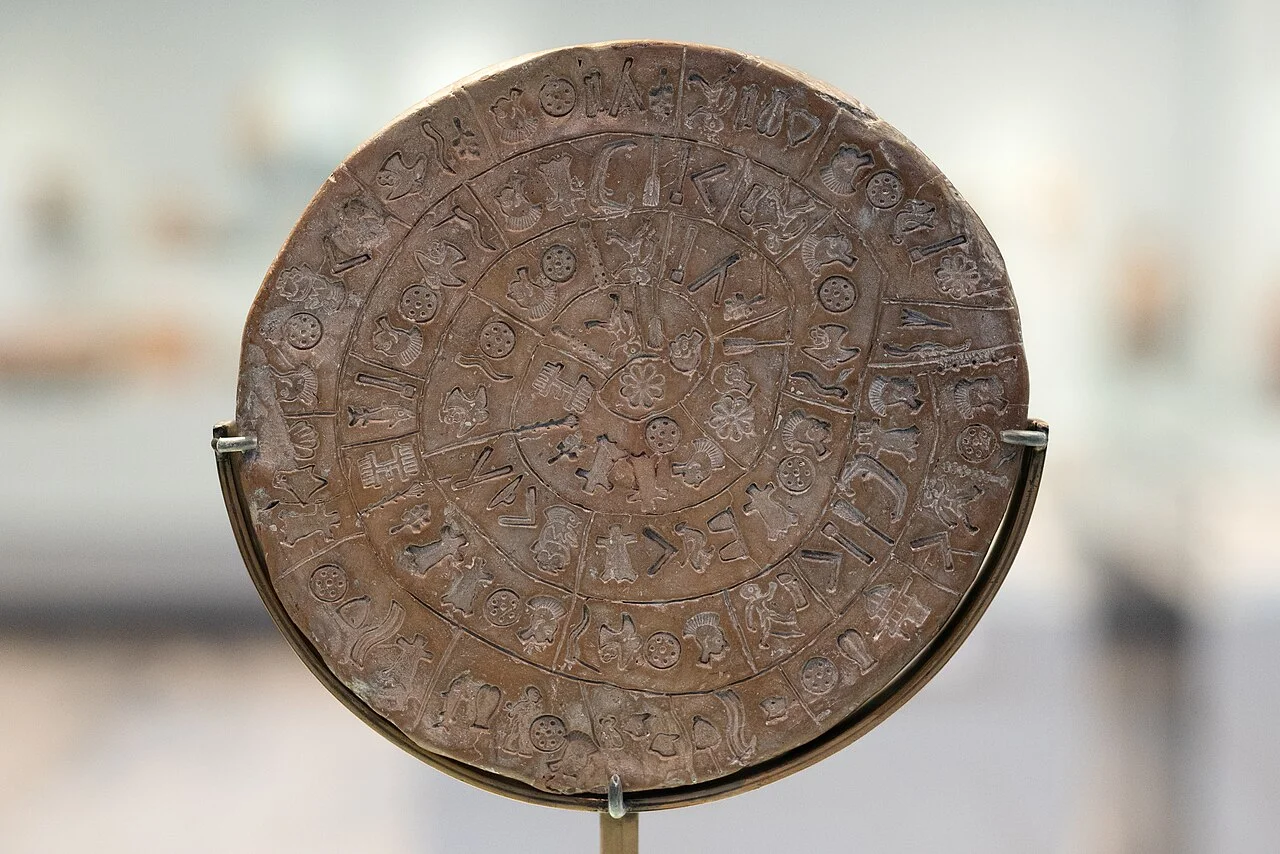
Luigi Pernier discovered the disc at Phaistos on Crete on July 3, 1908. Both faces carry spiral sequences made by pressing small stamps into wet clay. The object survives almost whole. Its language, message, and purpose remain unsettled. [1][2]
More context & timeline
Heraklion Museum dates it to about 1700–1650 BCE. Its catalogue records 241 signs in 61 groups. The repeated impressions reveal skilled, deliberate production. Those physical observations are firmer than any claimed translation, even when a proposed reading sounds persuasive. [1][2]
About 1700–1650 BCE
The museum places the disc in the Minoan Bronze Age. [1]
July 3, 1908
Pernier discovers it in the Phaistos archaeological complex. [1]
Continuing research
Comparisons test its signs against other early Aegean writing systems. [3]
Look closely
Follow the evidence
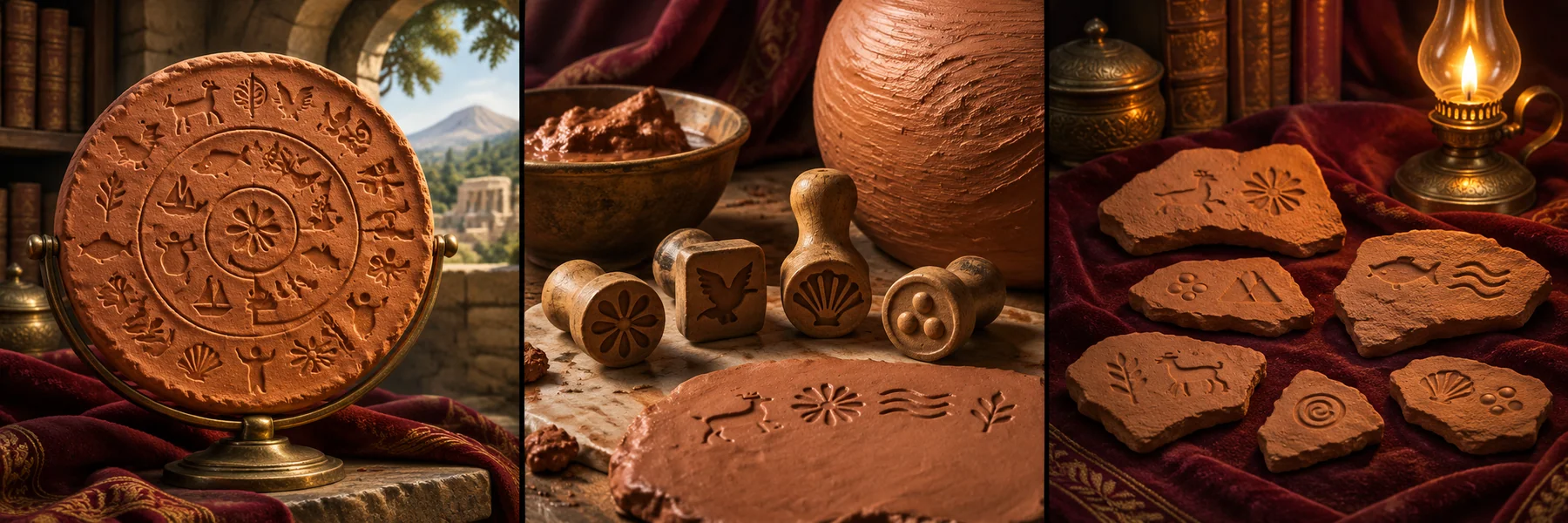
AI-generated scenes illustrate settings only. They do not reproduce the original disc, supply authentic signs, or validate a translation; use the museum photographs to inspect the evidence.
AI illustration · imagined scene
Evidence 1
Signs made with stamps
Repeated pictorial forms were impressed while the clay was soft. The production technique shows planned writing, without identifying a language or a particular author. [2]
AI illustration · imagined scene
Evidence 2
Groups that recur
Vertical divisions organize the signs into groups. Repeated groups suggest a refrain to some researchers, making a hymn or incantation worth considering. [1]
AI illustration · imagined scene
Evidence 3
A small comparison set
Mnamon identifies 45 different signs. Resemblances to other Cretan scripts are uncertain; no securely related corpus supplies a dependable key for checking an entire reading. [3]
1 / 3
Interpret the evidence
What could explain it?
Follow a possibility. Weigh what supports it. See where the evidence stops.
AI artwork sets the scene; it does not reconstruct an established answer.
AIExplore an explanationA hymn or incantation
The support
The museum considers the recurring groups the strongest indication of a religious text. [1]
The limit
Repetition alone cannot name a deity, recover a prayer, or establish particular spoken words. [1]
AIExplore an explanationA calendar or calendrical text
The support
Calendrical readings are among the documented attempts to explain the disc. Its ordered groups invite comparison with structured records. [3]
The limit
No proposed calendrical interpretation has achieved conclusive verification against comparable inscriptions. [3]
AIExplore an explanationA syllabic text in an unidentified language
The support
The size of the sign inventory supports a syllabic interpretation, broadly comparable in principle with other Aegean writing systems. [3]
The limit
This describes a possible way of encoding speech, not its content. A definite relationship to the other scripts remains unestablished. [3]
If a translation can explain every sign only after inventing a new rule, what prediction could make it testable?
Original object photograph
Connected place
Heraklion Archaeological Museum
The repository of the original disc; Phaistos is the place where it was found.
Resized without enlargement and converted to WebP; orientation follows source metadata. No manual crop or content alteration. The complete downloaded frame is preserved; card or banner display crops may be used. Image derivatives retain the stated image rights or license.
Scene artwork is AI-generated editorial illustration. Real photographs and original records retain their separate credits.
Sources & further reading
Original TrekBoundX writing. Research reviewed November 24, 2026. Source links do not imply institutional endorsement.