What were these carefully made objects actually for?
About the second–fourth centuries CE
The story
What we know
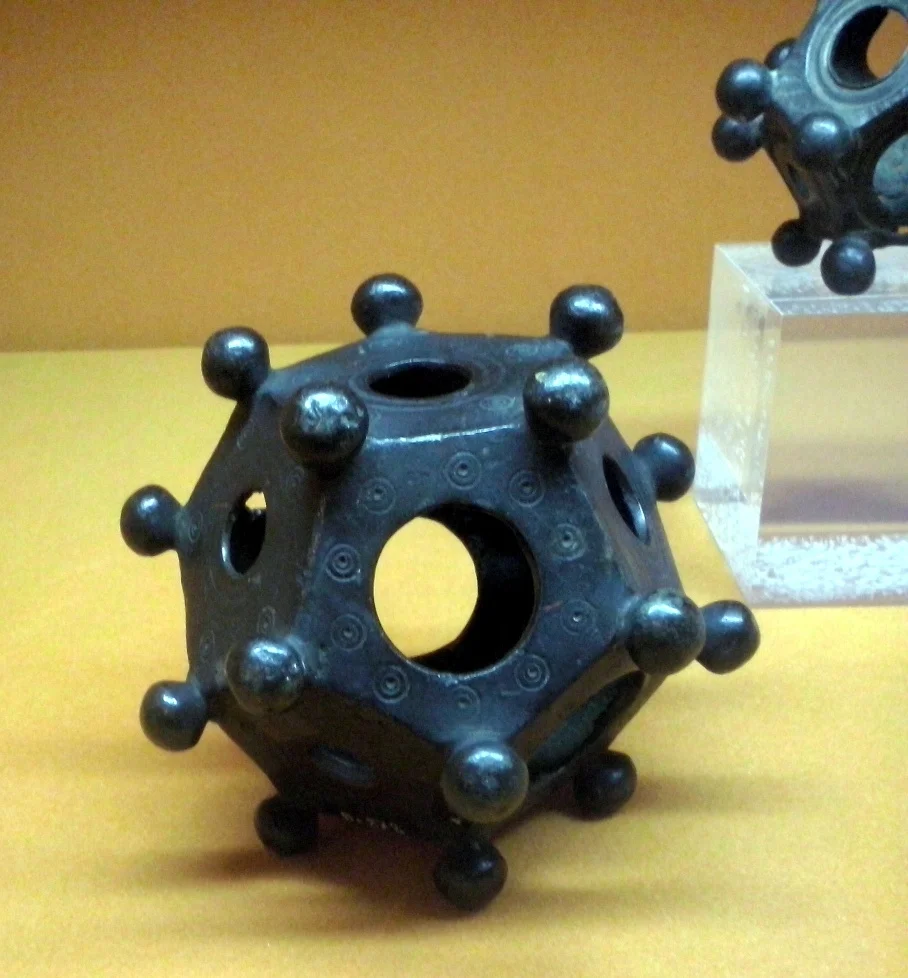
A Roman dodecahedron fits twelve pentagonal faces around a hollow centre. Each face has an opening, while small knobs mark the corners. Similar objects occur across the Roman north-west, yet their distinctive design has not led to an agreed explanation of their use. [1][3]
More context & timeline
Many examples lack clear excavation contexts, which makes function difficult to recover. A complete object found during a community excavation at Norton Disney in June 2023 provides a valuable new case. Its investigators continue to examine the setting rather than treating its discovery as a solved mystery. [1][3]
Second–fourth centuries CE
Secure contexts place examples broadly within this Roman-period range. [1]
June 2023
Community excavators uncover a complete example at Norton Disney. [3]
2025 research
A scholarly study revisits possible ritual and philosophical meanings. [4]
Look closely
Follow the evidence
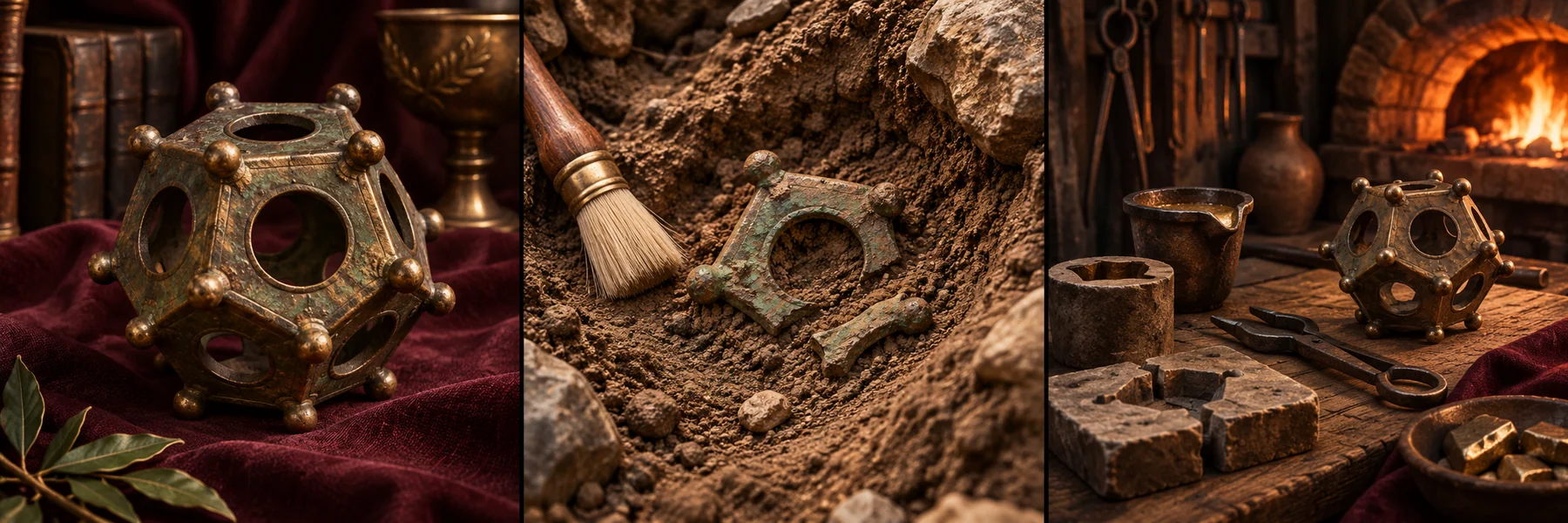
Imagined illustrations of manufacture and investigation. No scene establishes a function or reproduces a documented Roman use.
AI illustration · imagined scene
Evidence 1
Similar, without being standard
The objects share their basic form but vary in dimensions and openings. A common shape need not mean an identical use, and variation matters when testing proposed measuring functions. [1]
AI illustration · imagined scene
Evidence 2
A demanding piece of casting
Making a hollow copper-alloy object with this shape required skilled work. Craftsmanship indicates investment, although expense alone cannot distinguish a useful tool from a ritual object. [1]
AI illustration · imagined scene
Evidence 3
Condition meets context
Norton Disney’s excavators report little use-wear and investigate its placement in a former pit. Those observations motivate their religious interpretation without proving the object’s original function. [3]
1 / 3
Interpret the evidence
What could explain it?
Follow a possibility. Weigh what supports it. See where the evidence stops.
AI artwork sets the scene; it does not reconstruct an established answer.
AIExplore an explanationAn object for ritual or divination
The support
Limited wear and some religious associations make this a serious research possibility. [4]
The limit
A recent cosmological interpretation remains a hypothesis; no surviving instruction identifies a particular ceremony. [4]
AIExplore an explanationA measuring or sighting device
Check English Heritage for current opening and display information. Historical announcements for Norton Disney exhibitions are not current display guarantees.
AI illustration · imagined scene
Keep investigating
Step beyond the story.
Explore the connected place, examine the records, and form your own reading of the evidence.
Photo credits & full-image view
A Roman dodecahedron on display at the Gallo-Roman museum in Lyon, photographed in 2016.
Resized without enlargement and converted to WebP; orientation follows source metadata. No manual crop or content alteration. The complete downloaded frame is preserved; card or banner display crops may be used. Image derivatives retain the stated image rights or license.
Scene artwork is AI-generated editorial illustration. Real photographs and original records retain their separate credits.
Sources & further reading
Original TrekBoundX writing. Research reviewed November 24, 2026. Source links do not imply institutional endorsement.