
All mysteries

Ancient societies

The Peoples Behind the Sea Peoples

0 of 3 evidence items examined
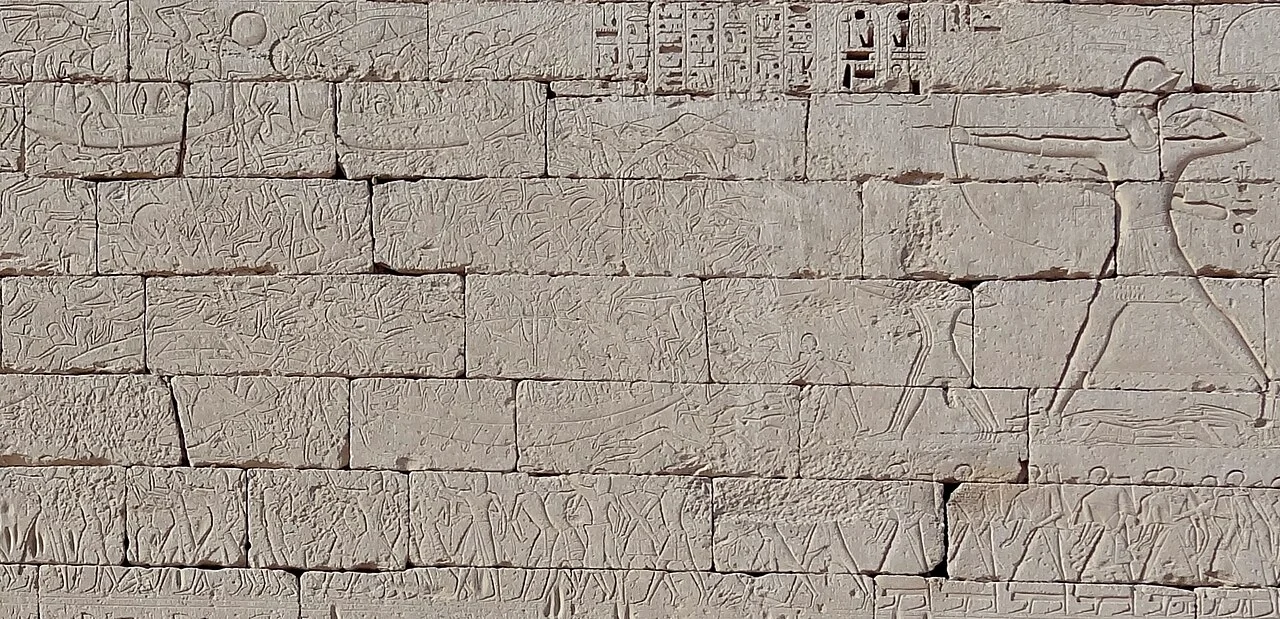
Carved figures in the Sea Peoples battle relief on the stone temple wall at Medinet Habu.View image
Ancient stone relief photograph

Who moved through the Mediterranean as Bronze Age kingdoms unravelled?

Late thirteenth–early twelfth centuries BCE

The story

What we know

At Medinet Habu, Ramesses III celebrated victory on land and water. Modern writers grouped several named peoples under the label “Sea Peoples.” They did not form one ancient race or organisation with an agreed homeland. [1] [2] [5]

More context & timeline

Egyptian records preserve group names and royal victory claims. Changes around the Mediterranean were uneven: destruction, migration, local continuity, and new communities. These groups participated in a wider crisis; treating them as the sole established cause of Bronze Age collapse exceeds the evidence. [1] [2] [5]

  1. Late thirteenth century BCE

    Egyptian records name groups later included under the modern Sea Peoples label. [1]

  2. Early twelfth century BCE

    Ramesses III commemorates battles at Medinet Habu, including his Year 8 campaign. [2]

  3. Early Iron Age

    Ashkelon evidence records population change alongside substantial local ancestry and cultural continuity. [3]
Look closely

Follow the evidence

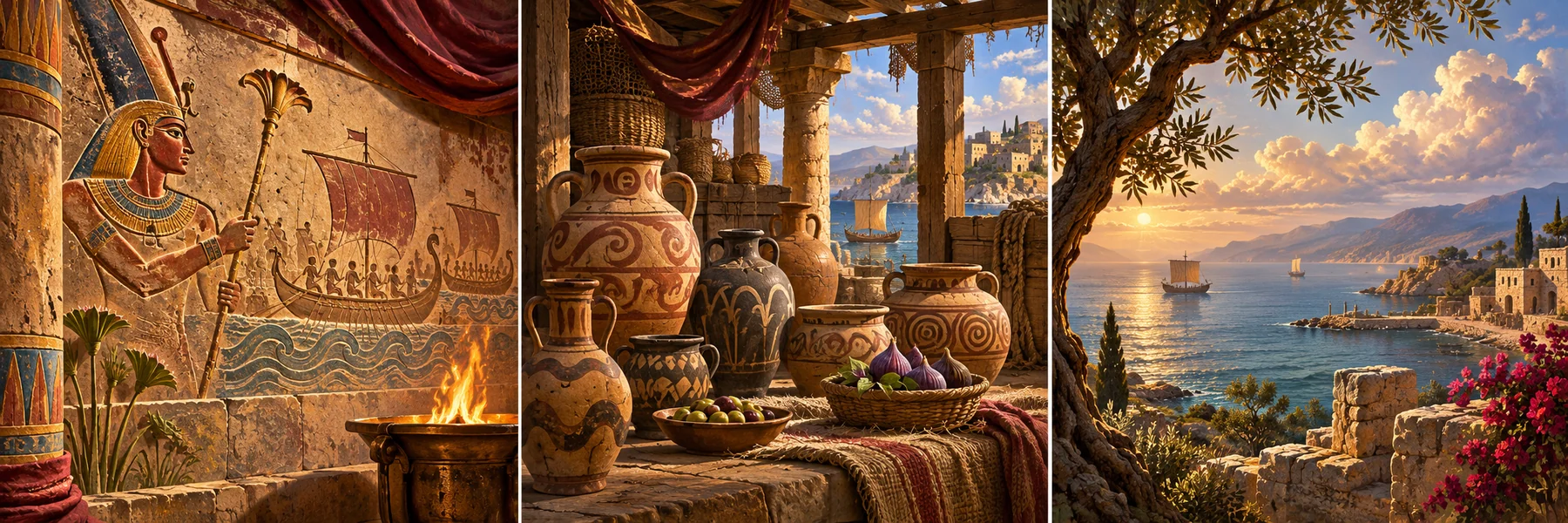
Imagined reliefs, objects and movement. These do not reconstruct a specific battle or portray the Sea Peoples as a single identified race.

AI-generated editorial illustration: An invented Egyptian-style relief
AI illustration · imagined scene
Evidence 1

Names behind the umbrella

Labels such as Peleset, Sherden, and Tjekker refer to named groups in ancient sources. Their appearances in different settings do not establish one shared origin, language, or political identity. [1]

AI-generated editorial illustration: An imagined pottery and coastal trade setting
AI illustration · imagined scene
Evidence 2

A king tells the story

The Medinet Habu inscriptions and images are primary evidence for Egyptian representations of conflict. They also glorify royal power, requiring comparison with evidence outside the monument. [2]

AI-generated editorial illustration: A conceptual ancient Mediterranean harbor
AI illustration · imagined scene
Evidence 3

Migration leaves a limited signal

Ancient DNA from a small Ashkelon sample found an additional European-related ancestry component in the early Iron Age. That supports some movement of people, not an identification of every named group. [3]

Interpret the evidence

What could explain it?

Follow a possibility. Weigh what supports it. See where the evidence stops.

AI artwork sets the scene; it does not reconstruct an established answer.

Explore an explanationPeople migrating and settling

The support

Population evidence at Ashkelon and changing material culture support arrivals that helped form new communities. [3]

The limit

One coastal city cannot map the movement of all groups or establish the motives of everyone who arrived. [3]

Explore an explanationMilitary groups and shifting alliances

The support

Egyptian battle records support real armed encounters involving named opponents, rather than an entirely invented threat. [2]

The limit

A royal victory narrative cannot show that those opponents destroyed every kingdom, or that all migrants were combatants. [2]

Explore an explanationCommunities adapting to wider disruption

The support

Research examines warfare, food pressures, environmental change, and the failure of interconnected political systems together. [5]

The limit

The causes and sequence vary by region. A broad crisis model cannot replace specific evidence for each community. [5]

If your only written account came from a victorious king, whose experiences might disappear?
Carved figures in the Sea Peoples battle relief on the stone temple wall at Medinet Habu.
Ancient stone relief photograph

Connected place

Temple of Ramesses III at Medinet Habu

The Egyptian monument preserving a major surviving account of these conflicts.

Visitor guide

The official site supplies visitor context for the temple at Luxor. Read its battle scenes as royal representations of history.

AI-generated editorial illustration: A conceptual ancient Mediterranean harbor
AI illustration · imagined scene

Keep investigating

Step beyond the story.

Explore the connected place, examine the records, and form your own reading of the evidence.

Photo credits & full-image view
A photograph of the ancient Sea Peoples battle relief at Medinet Habu, taken in 2014.

Olaf Tausch · Image source · CC BY 3.0

Resized without enlargement and converted to WebP; orientation follows source metadata. No manual crop or content alteration. The complete downloaded frame is preserved; card or banner display crops may be used. Image derivatives retain the stated rights or license.

Scene artwork is AI-generated editorial illustration. Real photographs and original records retain their separate credits.

Sources & further reading

Original TrekBoundX writing. Research reviewed November 24, 2026. Source links do not imply institutional endorsement.

  1. Ann E. Killebrew and Gunnar Lehmann / Society of Biblical LiteratureThe Philistines and Other “Sea Peoples” in Text and Archaeology: IntroductionExamine the source
  2. Epigraphic Survey / University of Chicago ISACMedinet Habu, Volume I: Earlier Historical Records of Ramses IIIExamine the source
  3. Feldman and colleagues / Science AdvancesAncient DNA sheds light on the genetic origins of early Iron Age PhilistinesExamine the source
  4. Egyptian Ministry of Tourism and AntiquitiesThe Temple of Medinet HabuExamine the source
  5. University of GothenburgThe collapse of Bronze Age societies in the Eastern Mediterranean: Sea Peoples in CyprusExamine the source
Suggest a correction
All mysteriesNext mysteryThe Ninth Legion’s Last Record

The Peoples Behind the Sea Peoples — image

Carved figures in the Sea Peoples battle relief on the stone temple wall at Medinet Habu.
A photograph of the ancient Sea Peoples battle relief at Medinet Habu, taken in 2014.

Olaf Tausch · Image source · CC BY 3.0

Resized without enlargement and converted to WebP; orientation follows source metadata. No manual crop or content alteration. The complete downloaded frame is preserved; card or banner display crops may be used. Image derivatives retain the stated rights or license.