
All mysteries

Maritime mysteries · Documented history

Titanic’s Surviving Evidence

0 of 5 evidence items examined
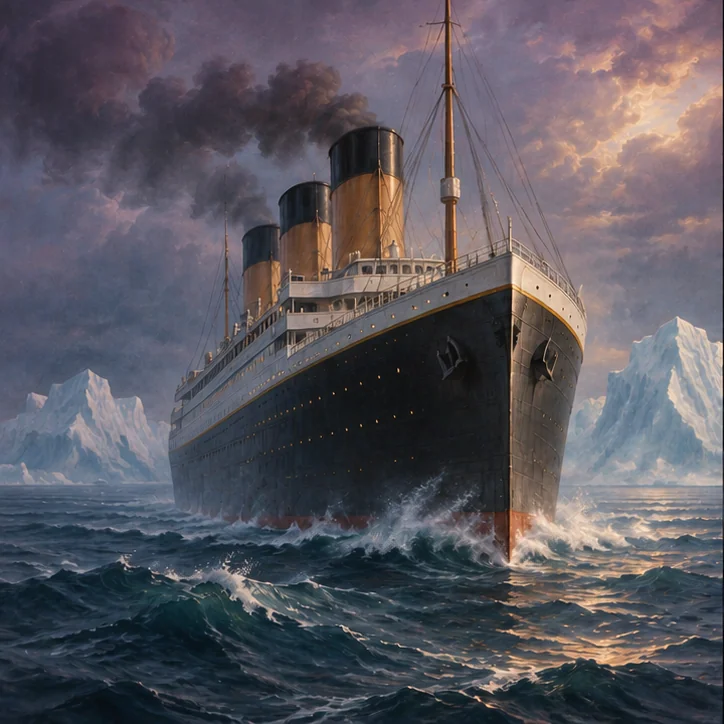
AI-generated editorial illustration: Imagined liner bow in Atlantic mistView image
AI illustration · imagined scene

What can testimony, court papers and the wreck establish about Titanic’s final hours?

1912–present

The story

What we know

Titanic struck an iceberg on April 14, 1912, and sank early the following morning. More than 1,500 people died. British and American investigations collected evidence almost immediately, decades before underwater cameras could examine the wreck. Their questions concerned navigation, warnings, lifeboats, regulation and responsibility. [1] [2] [3] [4]

More context & timeline

This case does not assume a missing dossier or a suppressed solution. The Senate transcripts, British inquiry and later liability proceedings form a substantial surviving archive. The wreck, located in 1985, adds physical evidence gathered under very different conditions. Each source has a history: testimony was recalled, court evidence was selected, and seabed remains have changed since the sinking. [1] [2] [3] [4]
  1. April 14–15, 1912

    Titanic strikes ice and founders in the North Atlantic. [1]

  2. 1912

    American and British inquiries examine the disaster. [1]

  3. September 1, 1985

    A joint French-American expedition locates the wreck. [3]

Look closely

Follow the evidence

These imagined scenes evoke the liner and investigation; they are not photographs of Titanic’s wreck, recovered evidence, or a newly discovered object.

AI-generated editorial illustration: Imagined liner bow in Atlantic mist
AI illustration · imagined scene
Evidence 1

Questions written before the wreck was found

The British investigation asked about the ship’s speed, course, wireless messages, equipment and evacuation. Its scope shows that the disaster was investigated as a chain of decisions and conditions, rather than one inexplicable event. [4]

AI-generated editorial illustration: Illustrated shipbuilding model and tools
AI illustration · imagined scene
Evidence 2

A second archive in court

National Archives guidance identifies the owner’s limitation-of-liability case and associated claims. A passenger’s account in litigation may answer a different question from testimony before a public inquiry. Comparing purposes helps explain differences without assuming dishonesty. [2]

AI-generated editorial illustration: Imagined deep-ocean search atmosphere
AI illustration · imagined scene
Evidence 3

A deep-water counterpart

The discovery expedition combined French search work with an American camera system. The seabed finally offered a way to compare a damaged ship with human recollections. Images are powerful evidence, but their interpretation still depends on context and survey coverage. [3]

AI-generated editorial illustration: Imagined liner bow in Atlantic mist
AI illustration · imagined scene
Evidence 4

Eighty-two witnesses, one enormous transcript

The Senate investigation began on April 19, 1912, and heard 82 witnesses. Its published testimony runs to more than 1,100 pages. This near-contemporary American record can be compared with the British inquiry, while keeping each witness’s location, experience and opportunity to observe in view. [1]

AI-generated editorial illustration: Illustrated shipbuilding model and tools
AI illustration · imagined scene
Evidence 5

The rescue has a record of its own

The Senate’s guide links a 1912 law honouring Carpathia’s captain, officers and crew for rescuing Titanic’s survivors. The disaster’s documentary trail therefore continues beyond the sinking. Records of rescue and recognition answer different questions from findings about the collision or responsibility for it. [1]

Interpret the evidence

Fact, record and legend

Follow a possibility. Weigh what supports it. See where the evidence stops.

AI artwork sets the scene; it does not reconstruct an established answer.

Explore an explanationCollision, flooding and operational decisions

The support

The inquiry records support an iceberg collision followed by catastrophic flooding, examined alongside speed and warnings. [4]

The limit

An established overall sequence does not make every manoeuvre, timing estimate or individual observation equally certain. [4]

Explore an explanationLoss amplified by evacuation conditions

The support

Investigators examined life-saving provision, organisation and regulation because survival depended on more than damage to the hull. [1]

The limit

Responsibility cannot be assigned from a single dramatic detail while ignoring the wider record. [1]

Explore an explanationAn apparent mystery created by missing context

The support

Separated transcripts, claims and wreck images can appear contradictory until their dates and purposes are compared. [2]

The limit

A gap deserves investigation, but absence of a particular document does not establish deliberate suppression. [2]

Would you give more weight to an immediate eyewitness statement, a later legal claim, or an underwater image—and what question could each actually answer?
AI-generated editorial illustration: Imagined liner bow in Atlantic mist
AI illustration · imagined scene

Connected place

Smithsonian Titanic resources

Public learning materials connect objects, maritime history and the wreck.

Visitor guide

This is a learning destination, not access to the protected deep-water wreck or a guarantee of particular displays.

AI-generated editorial illustration: Imagined deep-ocean search atmosphere
AI illustration · imagined scene

Keep investigating

Step beyond the story.

Explore the connected place, examine the records, and form your own reading of the evidence.

Photo credits & full-image view
AI-generated editorial illustration for Titanic’s lost evidence. It is an imagined scene, not a historical photograph or source evidence.

Created for TrekboundX · Image source · AI artwork details

Left panel extracted from a generated triptych and optimized as WebP without enlargement. The original PNG and generation prompt are preserved in the project artwork ledger.

Scene artwork is AI-generated editorial illustration. Real photographs and original records retain their separate credits.

Sources & further reading

Original TrekBoundX writing. Research reviewed November 26, 2026. Source links do not imply institutional endorsement.

  1. United States SenateTitanic Disaster Hearings: official investigation resourcesExamine the source
  2. National ArchivesThey Said It Couldn’t Sink: Titanic records guideExamine the source
  3. Woods Hole Oceanographic InstitutionForty years after the Titanic discovery (2025)Examine the source
  4. United Kingdom Board of Trade / U.S. Government Publishing OfficeLoss of the Steamship Titanic: formal investigation report (1912)Examine the source
Suggest a correction
All mysteriesNext mysteryLincoln’s Assassination and Booth’s Flight

Titanic’s Surviving Evidence — image

AI-generated editorial illustration: Imagined liner bow in Atlantic mist
AI-generated editorial illustration for Titanic’s lost evidence. It is an imagined scene, not a historical photograph or source evidence.

Created for TrekboundX · Image source · AI artwork details

Left panel extracted from a generated triptych and optimized as WebP without enlargement. The original PNG and generation prompt are preserved in the project artwork ledger.