What could make a large naval vessel disappear without a confirmed wreck?
1918
The story
What we know
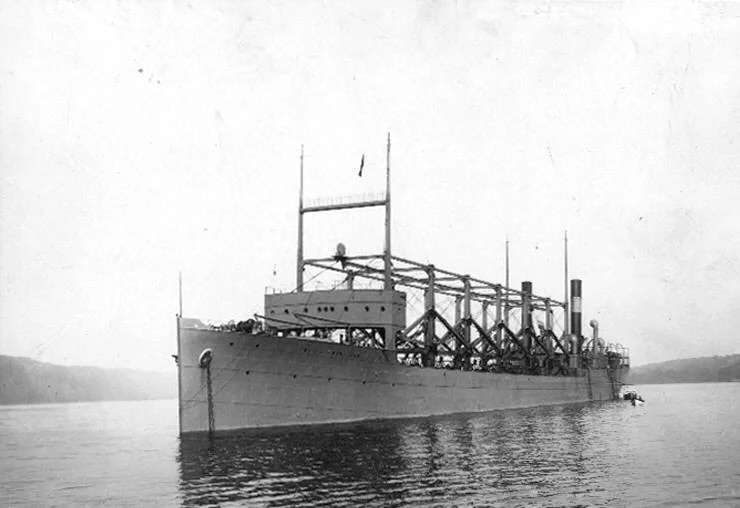
After calling at Barbados in March 1918, the U.S. Navy collier Cyclops continued toward Baltimore carrying manganese ore. She never arrived. No confirmed wreck has explained the loss of the crew and passengers, and the cause remains unknown. [1][2]
More context & timeline
Cyclops had been built to carry coal and support other ships. The final cargo was denser ore, and reports described machinery problems. The absence of a wreck prevents investigators from examining the hull, cargo, and machinery together. A plausible engineering explanation therefore remains a reconstruction, rather than a forensic finding from the seabed. [1][2]
1910
Cyclops enters service as a naval support vessel. [1]
Searches and investigation fail to establish a wreck location or cause. [3]
Look closely
Follow the evidence
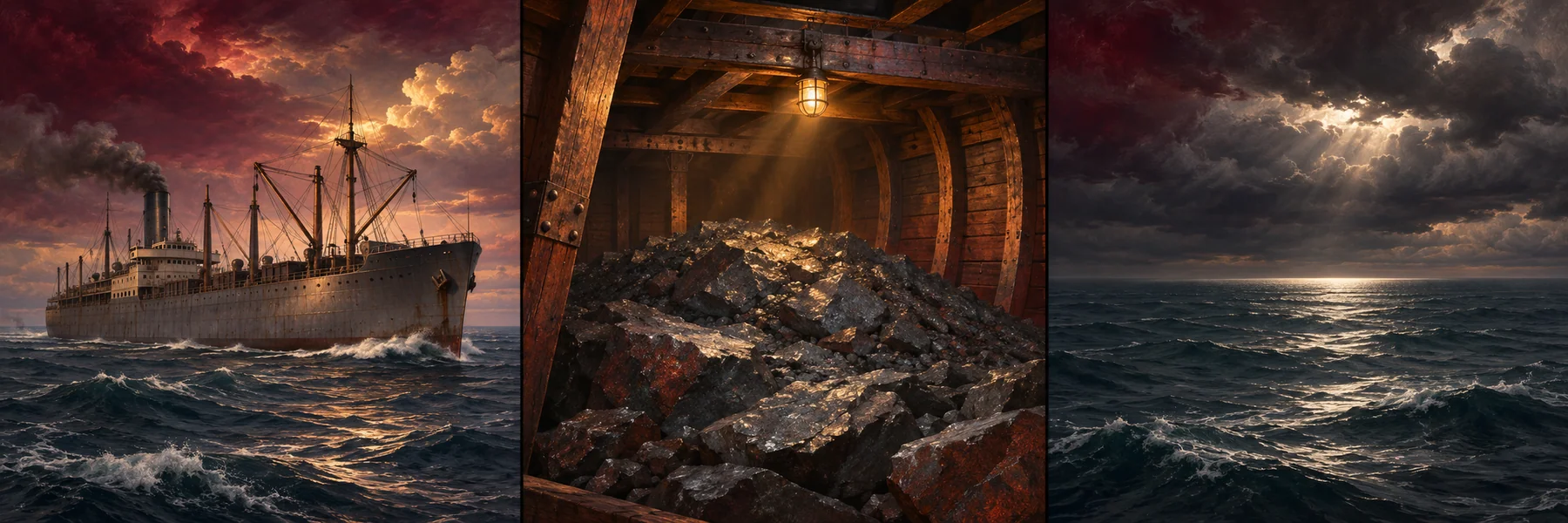
Imagined ship, cargo and ocean scenes. They do not show a verified wreck, final position or established cause of the ship’s loss.
AI illustration · imagined scene
Evidence 1
An unusual cargo for the design
The ship was designed around coal transport. Dense manganese ore makes loading and structural stresses relevant questions, but cargo type alone does not demonstrate how the vessel failed. [1]
AI illustration · imagined scene
Evidence 2
Trouble before the final passage
Worley reported a cracked starboard engine and an inoperative cylinder before departure from Brazil. That documents a concern; it does not identify the event that ultimately sank the ship. [2]
AI illustration · imagined scene
Evidence 3
No matching enemy account
Contemporary investigators considered wartime attack. Later examination of German records did not establish a submarine action explaining the disappearance. An unlocated loss during a war is not automatically a combat loss. [4]
1 / 3
Interpret the evidence
What could explain it?
Follow a possibility. Weigh what supports it. See where the evidence stops.
AI artwork sets the scene; it does not reconstruct an established answer.
AIExplore an explanationCatastrophic structural failure
The support
NHHC’s historical assessment favours an interaction between the design, dense cargo, possible weakening, and heavy seas. Related losses among sister ships make comparison useful. [1]
The limit
No recovered hull confirms a fracture pattern or establishes which stresses were decisive. [1]
AIExplore an explanationMachinery failure followed by severe conditions
The support
Documented engine trouble could have reduced the vessel’s ability to cope with conditions or complete her passage. [2]
The limit
A disabled engine does not by itself explain the complete disappearance. The final weather and sequence remain uncertain. [2]
AIExplore an explanationEnemy attack or sabotage
The support
War and rumours about command created early suspicion, making these understandable lines of inquiry. [1]
The limit
No evidence established disloyalty or a German attack. National origin and an unpopular captain are not proof of sabotage. [1]
What damage on an authenticated wreck could distinguish a ship breaking under stress from one sinking after an external attack?
Archival ship photograph
Connected place
National Museum of the United States Navy
An institutional learning connection preserving the ship’s photographs and history.
Resized without enlargement and converted to WebP; orientation follows source metadata. No manual crop or content alteration. The complete downloaded frame is preserved; card or banner display crops may be used. Image derivatives retain the stated rights or license.
Scene artwork is AI-generated editorial illustration. Real photographs and original records retain their separate credits.
Sources & further reading
Original TrekBoundX writing. Research reviewed November 24, 2026. Source links do not imply institutional endorsement.