
All mysteries

Codes & manuscripts

The Voynich Manuscript

0 of 3 evidence items examined
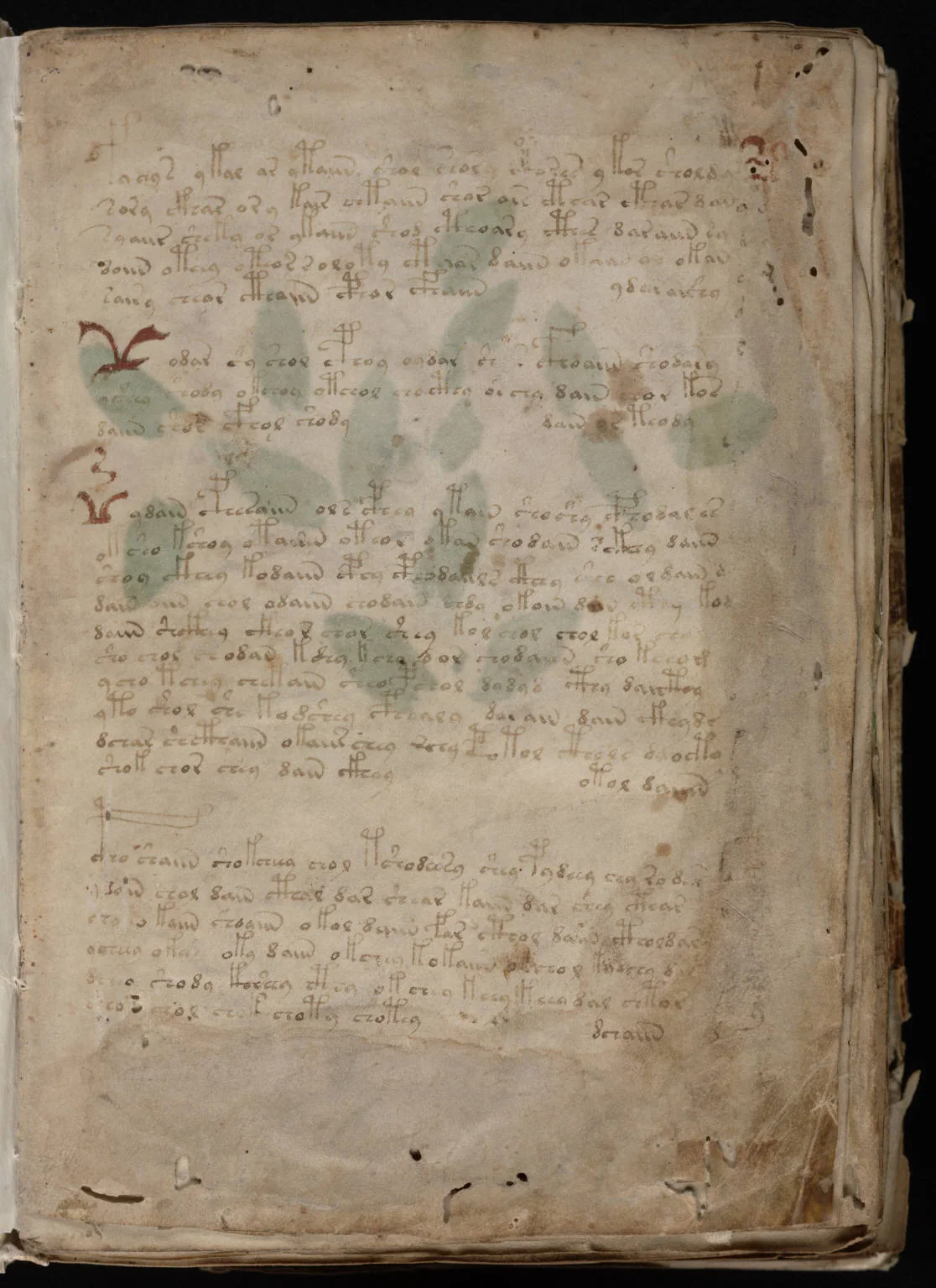
A parchment page covered with the Voynich manuscript’s unfamiliar script and faded pigment.View image
Authentic manuscript scan · detail

What does this extraordinary book actually say?

Medieval manuscript

The story

What we know

A richly illustrated manuscript survives at Yale, filled with an unfamiliar script. Its pages appear carefully organized, but recognizing patterns is not the same as reading words. The author, language, and purpose remain unsettled. [1]

More context & timeline

Scientific and material research places the book within the medieval manuscript tradition. Wilfrid Voynich bought it near Rome in 1912; H. P. Kraus gave it to Yale in 1969. Its modern name records an owner, not an identified author. [1]
  1. Medieval period

    Materials and handwriting place the manuscript in a medieval context. [1]

  2. 1912

    Wilfrid Voynich purchases the manuscript near Rome. [1]

  3. 1969

    H. P. Kraus donates it to Yale. [1]

Look closely

Follow the evidence

Imagined manuscript imagery and symbols. Yale’s actual folios remain linked separately.

Examine the original
AI-generated editorial illustration: An invented botanical manuscript illustration
AI illustration · imagined scene
Evidence 1

Illustrations suggest an organization

Plants, celestial diagrams, baths, and pharmaceutical-looking imagery divide the book into recognizable visual groups. They suggest subjects, but do not translate the accompanying script. [1]

AI-generated editorial illustration: Quills and parchment on a writing desk
AI illustration · imagined scene
Evidence 2

More than one hand

Yale’s account of paleographic research identifies five contributing scribes. Collaboration complicates the idea of a solitary creator, without identifying the writers. [2]

AI-generated editorial illustration: Abstract unreadable glyph patterns
AI illustration · imagined scene
Evidence 3

Patterns without a key

The text has strong statistical regularities. Linguists can test possible structures against them, but patterned writing alone does not establish a successful decipherment. [3]

Interpret the evidence

What could explain it?

Follow a possibility. Weigh what supports it. See where the evidence stops.

AI artwork sets the scene; it does not reconstruct an established answer.

Explore an explanationLanguage in an unfamiliar writing system

The support

Linguistic research finds structural reasons to examine the text as language. [3]

The limit

No proposed language identification has produced an accepted reading of the manuscript. [3]

Explore an explanationMeaning transformed by a cipher

The support

An encoding process could explain why familiar words are not visible. [3]

The limit

A convincing solution must explain the manuscript consistently, rather than fit a few selected passages. [3]

Explore an explanationText generated without recoverable meaning

The support

Researchers have considered deliberately produced, language-like text. [3]

The limit

Statistical resemblance alone cannot settle whether the writing carries meaning or what its maker intended. [3]

What would a convincing translation need to predict on a page its author had not used to build the theory?
A parchment page covered with the Voynich manuscript’s unfamiliar script and faded pigment.
The manuscript held at Yale

Connected place

Beinecke Rare Book & Manuscript Library

The manuscript’s repository at Yale in New Haven, not its place of creation.

Library guide

The original is subject to access restrictions. A visit does not guarantee that it will be on display; the digital manuscript is available above.

AI-generated editorial illustration: Abstract unreadable glyph patterns
AI illustration · imagined scene

Keep investigating

Step beyond the story.

Explore the connected place, examine the records, and form your own reading of the evidence.

Photo credits & full-image view
An actual page of the Voynich manuscript, folio 1r, held at Yale.

Unknown medieval maker; digital image from the Beinecke Rare Book & Manuscript Library, Yale University · Image source · Public domain

Resized and converted to WebP. Cards and banners show display crops; the expanded image preserves the complete downloaded frame. Adapted images retain the stated image license.

Scene artwork is AI-generated editorial illustration. Real photographs and original records retain their separate credits.

Sources & further reading

Original TrekBoundX writing. Research reviewed November 23, 2026. Source links do not imply institutional endorsement.

  1. Yale Beinecke LibraryThe Beinecke Cipher (Voynich) ManuscriptExamine the source
  2. Yale NewsDeciphering a mysterious manuscriptExamine the source
  3. Bowern & Lindemann, YaleThe Linguistics of the Voynich Manuscript (research PDF)Examine the source
Suggest a correction
All mysteriesNext mysteryThe Antikythera Mechanism

The Voynich Manuscript — image

A parchment page covered with the Voynich manuscript’s unfamiliar script and faded pigment.
An actual page of the Voynich manuscript, folio 1r, held at Yale.

Unknown medieval maker; digital image from the Beinecke Rare Book & Manuscript Library, Yale University · Image source · Public domain

Resized and converted to WebP. Cards and banners show display crops; the expanded image preserves the complete downloaded frame. Adapted images retain the stated image license.